




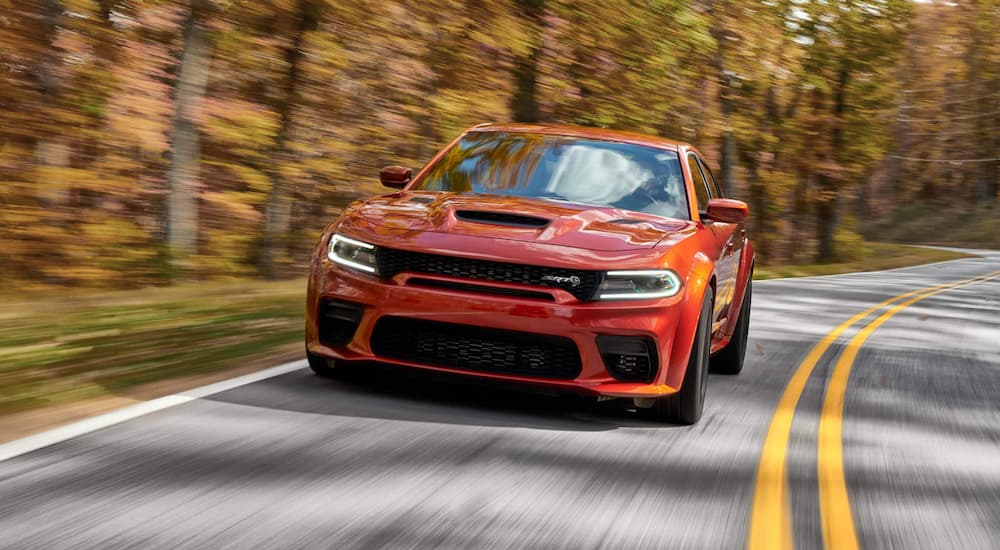
Do you want an all-American muscle car? Something that looks mean, has a great profile, puts down lots of power, and gives you the sort of exhilaration and excitement on the road you just won’t find from any other vehicle? Then hands down, you’re going to be eyeing two of the most popular (and two of the last remaining) muscle cars on the market today: the Dodge Charger and the Dodge Challenger. But as you prepare yourself to make a purchase, you’re likely asking, “When I visit a Dodge dealer near me, should I get a Challenger or a Charger?”
It’s an age-old question that dates back decades when it comes time to pick between two similar vehicles from the same brand. They’re both power-hungry cars that burn rubber and are known for their iconic HEMI V8 engines. But which one is right for you? And if given the opportunity, which one should you buy? We’re here to help you iron out a game plan so you know which one to buy and why. This way, when it’s time to visit us at Spirit CDJR, you’ll know exactly which car suits your budget and your rubber-burning desires. So let’s get started with the basics.
Two-Door vs Four-Door
If you’re unfamiliar with the Dodge Charger and Dodge Challenger, the most obvious difference between the two vehicles is that one is a sports coupe, and the other is a sports sedan. The Challenger is a two-door notchback, while the Charger is an almost full-size four-door sedan. This makes a decided difference in terms of size, cabin volume, and cargo capacity. It also impacts the performance of the two cars, as the Challenger lives up to its sportier looks.
Now, just because the Challenger is a two-door coupe doesn’t mean that the seating arrangements are limited to just two people. In fact, the Challenger actually seats up to five people across two rows. There are even 94 cu.ft. of passenger space and 33.1 inches of rear legroom. Given its size, the Challenger could be a family vehicle, but it wouldn’t make for the most practical family vehicle even if you have small kids who don’t mind sitting in the back. While it can fit up to five people, the Challenger was built for speed.
The Charger also seats up to five people across two rows. However, it comes in a four-door configuration. Unlike the Challenger, the Charger is designed to be more convenient for families with its four doors and larger passenger volume. Thanks to the more spacious cabin, you can comfortably fit a couple of kids and a pet inside. You get a total passenger volume of 105 cu.ft. with an impressive 40.1 inches of rear legroom.
Additionally, both vehicles offer some impressive trunk space, with the Charger’s trunk capacity clocking in at 16.5 cu.ft. of space and the Challenger’s being only slightly smaller at 16.2 cu.ft. of space. You won’t have any problems storing goods in either vehicle. However, you do get more interior options with the Challenger.
Both cars have several different interior color choices available, including Black, Caramel, Ruby Red, Sepia, Hammerhead Gray, and Demonic Red. But the Challenger has both Sport Seats and Performance Seats available in well over a dozen different options, including a variety of materials from Houndstooth cloth to Laguna leather and Alcantara. If interior customization is high on your wishlist for a vehicle, then the Challenger and Charger offer it up in spades.
Rear-Wheel Drive vs All-Wheel Drive
Are you wondering, “Should I go with a rear-wheel drive or all-wheel drive car?” Then you will be pleased to know that both the Dodge Charger and Dodge Challenger are available in rear-wheel drive or all-wheel drive. Both vehicles offer all-wheel drive with their SXT and GT trims, although every other trim is rear-wheel drive only. Where the two cars differ is in performance. Both offer Pentastar V6 and HEMI V8 powertrains, but you get more performance out of the Challenger compared to the Charger.
While the horsepower and torque are very similar between the two, the entry-level Charger tops out at 292 hp with a Pentastar V6, while the base Challenger has 303 hp from the same engine. Further, the Charger is a larger vehicle with more weight to move around and more passenger volume, which comes at the expense of peak performance. So obviously, you can obtain slightly better performance in the Challenger if that’s what you’re gunning for.
However, both vehicles offer a wide range of powertrain options beyond the Pentastar V6, including a 5.7L HEMI V8, a HEMI 392 V8, a supercharged Hellcat V8, and a High-Output Hellcat V8. Which trim you choose will determine which engine is paired with the vehicle and how much performance you can get out of it. If you want a rear-wheel drive vehicle that’s all about maximum power, you can get it from either the Charger or the Challenger. Alternatively, if you want an all-wheel drive option for better traction and stability, you can take advantage of that from both vehicles as well.
Jailbreak vs SRT Super Stock
When it comes to the trim selection, the newer Charger and Challenger model years offer many of the same trims. The SXT, GT, R/T, Scat Pack, Scat Pack Widebody, SRT Hellcat Redeye Widebody, and Jailbreak are shared between both vehicles. But keeping with the theme of performance, the Challenger is available in SRT Hellcat and SRT Hellcat Redeye trims with or without the widebody modification. It’s something to consider depending on which trim speaks to you most.
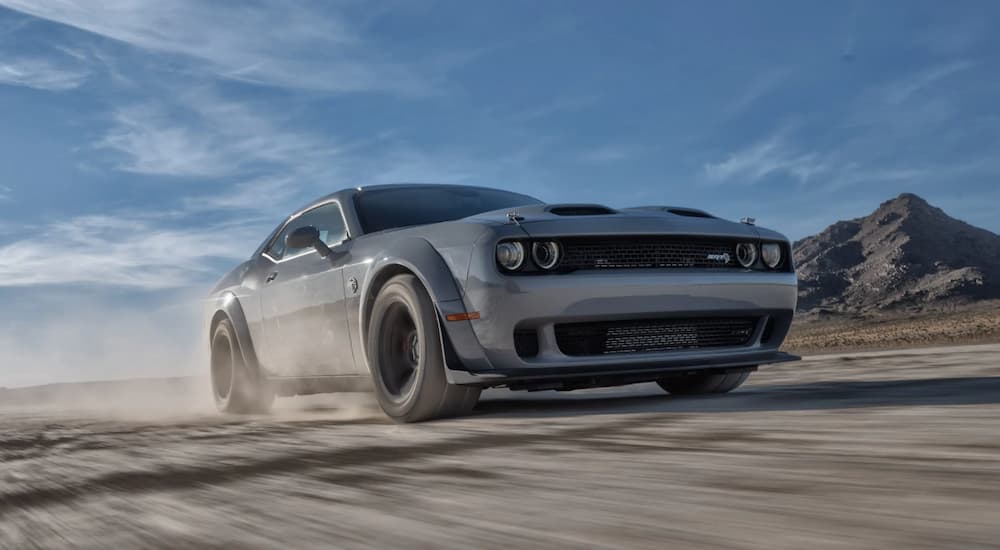
However, the biggest divergence between the two vehicles comes in the form of the top-end trims. For the Charger, the top trim available is the Jailbreak, which comes with the 6.2-liter High-Output Hellcat V8. It produces 797 hp and 707 lb-ft of torque, making it an absolute monster. The Challenger is also available in the Jailbreak trim, but its version tops out at 807 hp and 707 lb-ft of torque, just edging out the Charger in terms of performance.
Alternatively, the Challenger also has the SRT Super Stock as its top trim (previous model years offered the now legendary Demon, but sadly it’s no longer available). This trim is designed for drag racing, much like the Demon, allowing the Challenger to hit 0 to 60 mph in just 3.25 seconds, making it even faster than the Challenger Jailbreak. It also comes standard with Nitto NT05R Drag Radial Tires. Unfortunately, the Super Stock is not available for the Charger. So there is a difference in the top-end performance capabilities between the two vehicles, with the availability of certain trims like the Super Stock being exclusive to the Challenger.
Price vs Convenience
Whether you decide to go with the Challenger or Charger depends on your budget, driving preferences, and what you feel is most convenient to own. If you have a family, then the Charger is probably going to be the better choice. If you’re on a budget and it’s just you, the Challenger GT and R/T are the more affordable options, both with a starting MSRP that’s under $40,000. In fact, the Challenger R/T starts at $39,075, whereas the Charger R/T starts at $41,405.[a]
If you need the space and cabin volume, the Charger will be your better bet. If you want maximum power, then the Challenger is the better option. Both have a unique set of exterior colors, but you definitely get a more varied interior selection with the Challenger if that’s something that might persuade you in your purchasing decision. So now, if you’re thinking, “Which high-performance Dodge muscle car should I get?” you have a better idea of what each one offers. Hopefully, it will make it easier when it’s time to settle on a purchase.
[a]MSRP subject to change. Please see dealer for details.
Factory Ordering a Custom Jeep
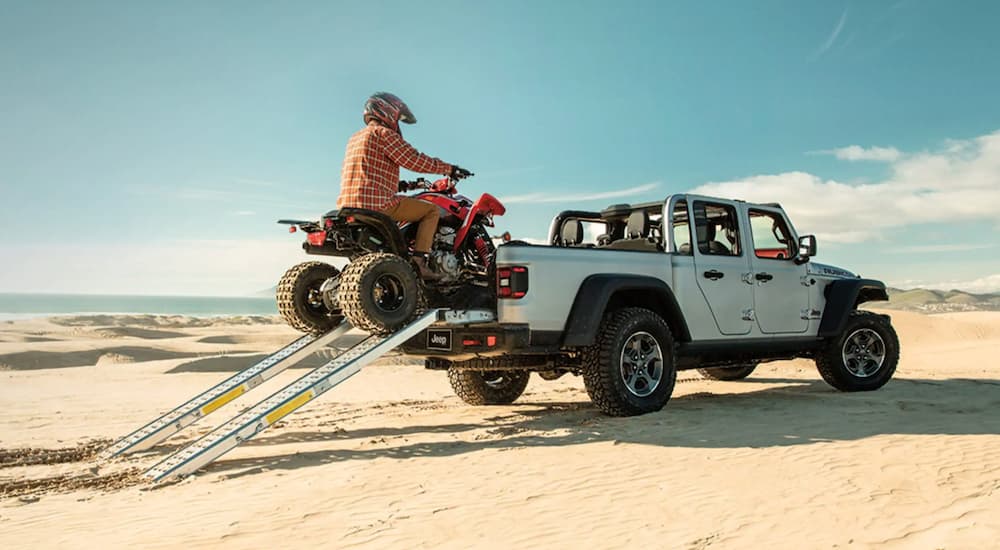
In today’s world of online commerce, purchasing goods and services has become easier than ever. With the quick tap of an app, we can order food, clothes, and other necessary amenities that make our lives comfortable. Before the global pandemic, many people had no choice in how they acquired various goods. Due to the growing necessity for quarantining and social distancing, online ordering became common practice as most of the world’s workforce had to resort to working remotely. It’s only natural that the process of purchasing an automobile would join the list of products that are available to anyone with an internet connection and a driver’s license.
At Spirit CDJR, we know Jeep, the fleet, the history, and most importantly, the advantages of owning one. For those who enjoy online shopping, you’ll be pleased to know that you can factory order Jeep vehicles and have them custom-made to your specifications. That’s right, and you can order a Wrangler in the same fashion that you can order your weekly groceries, and it’s easy to do right here on our website. If you’ve been curious about the process and its advantages, we’re here to answer all of your questions.
What Are the Advantages of Factory Ordering Your Jeep?
Let’s backtrack to the food analogy for a brief moment. Imagine you sit down at a restaurant. You place your order, but you’re not given a chance to tell the waiter or waitress the specifics of how you want your meal prepared. The result is something that might taste good and feel fulfilling, but there are a few ingredients that you could do without and maybe a few that are missing that would have been to your liking. In a nutshell, choosing to factory order your Jeep means that you’ll have what you want and none of what you don’t. You’ll be able to customize your trim level to your liking and precise specifications.
Going through the factory means you won’t have to settle for something that someone else wanted but might not match your liking. After all, you wouldn’t order a pizza with anchovies if you don’t even like them, would you?
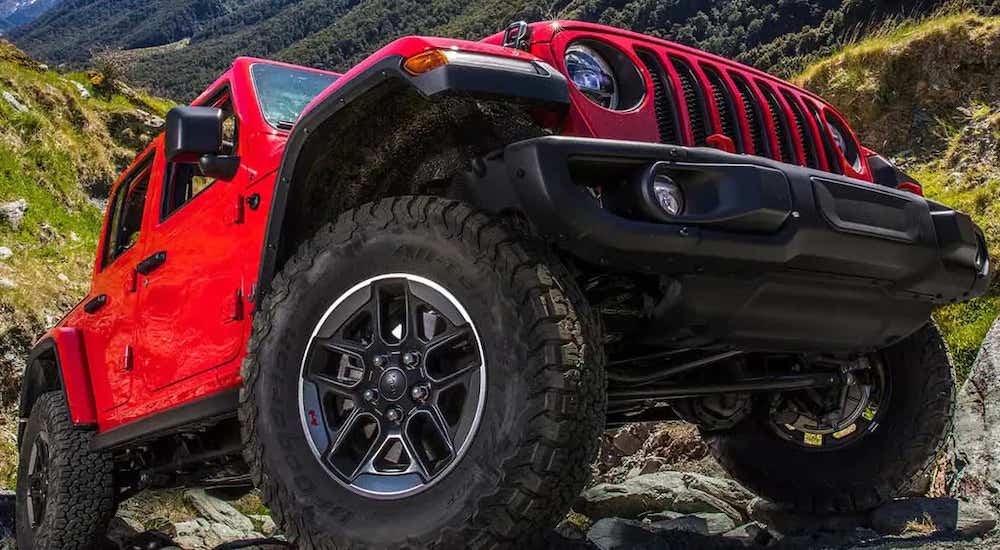
The Ordering Process Is Simple
You’ll have more options than ever when you start to build your own model. The vehicle selection isn’t limited to just a few models or select trims; the entire Jeep fleet is available for complete customization. The choice is yours to do what you want, from the exterior color to interior amenities. We’ve decided to walk through a hypothetical process to illustrate how easy the process is and the options you’ll have to work with.
Start by choosing the type of Jeep you want. Whether you want to go with the Wrangler, Compass, or Grand Wagoneer, they’re all here to choose from. For this exercise, we’ll be going with the Jeep Wrangler, as the Wrangler is one of the most popular models on the road today.
Next, you’ll want to find the ideal trim level that agrees with your wants and needs. For instance, if you’re buying a 2022 Jeep Wrangler, you’ll have a total of twelve different trims to choose from, each one with its own unique advantages. Take a look at the starting MSRP for each one; this will give you an idea of where your customization process begins. It’s important to stay within your means and don’t overspend. We advise setting up a budget before the ordering process to keep things affordable.
Once your model and trim level have been chosen, it’s time to choose the type of exterior you want. You’ll have some important choices to make. While color is usually easy, there are other chances to fine-tune your Jeep with items such as tires, wheels, and even door handles. If you’ve ever wanted to turn heads, here’s your opportunity. After all, you only get one chance to make a first impression.
While spectators will notice the exterior of your Jeep, it’s the interior where you can really put your own signature on your vehicle. This is the throne upon which you’ll sit and survey your kingdom and the terrain you wish to explore and conquer. Opting for a stylish interior can make all the difference in your commute. Here, you’ll choose which color scheme works best for you. You’ll also have the chance to decide upon what infotainment screen you like and items such as dual-zone climate control. Remember, this is where you’ll spend most of your time; make it count.
The ultimate choice you have in front of you is which powertrain you would like to utilize. For instance, the Wrangler has three distinct engines, each one having its own advantages depending on what you plan on using your newly acquired vehicle for. The standard engine for the Wrangler is a 3.6L Pentastar V6. Known for its resiliency and durability, some users can get over 200,000 miles of service when the engine is properly maintained. With 285 horsepower and the ability to generate 260 lb-ft of torque, you’ll have the ability to tow 3,500 lbs with minimal effort.
For those who want a slimmed-down motor that still delivers plenty of performance, a 2.0L Turbocharged inline-four cylinder is also available, with 270 horsepower and the ability to generate an impressive 295 lb-ft of torque. This ultimate adventure machine comes with four-wheel drive, and to maximize control over the drive, there’s the option for a six-speed manual transmission or an 8-speed automatic transmission. The 6-speed manual is only available for the 3.6L V6 engine, so if you want one of the other engines, you’ll get the 8-speed automatic by default.
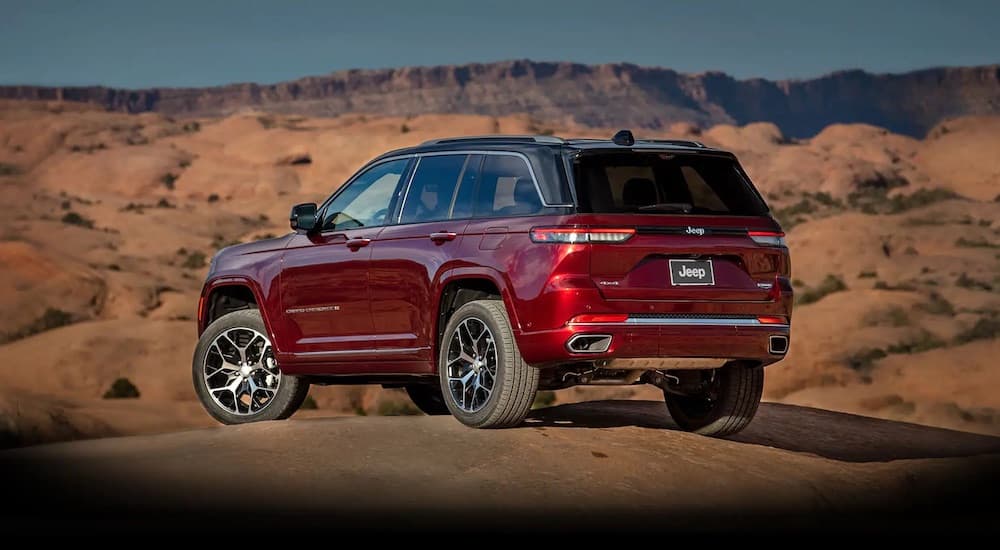
Are There Any Disadvantages of Ordering From the Factory?
Should you decide to order from a factory, there are a couple of things that you should be aware of before placing your order. Ordering anything that is custom-built to your specifications means having to wait for an undetermined period of time. Some locations work faster than others, and depending on if a location has all the necessary parts can make a considerable impact on production and delivery times.
Depending upon what you have done, there is a slight possibility that customization can affect resale value. While your new Jeep can be customized to fit your needs, it might not adhere to someone else’s. Any vehicle you purchase is an investment, and it’s good to put a lot of thought into making the choice that best suits you. On the opposite end, parts that are built for better performance might add to the resale value. It all depends on how much life you want out of your vehicle.
Making the Right Choice
While having a Jeep custom-made to a person’s precise specifications isn’t for everyone, it’s a great way to have a vehicle that has a very unique and personal touch. It can be a choice that presents many options on what works best for you and your situation. When you visit Spirit CDJR, you’ll find a team that’s in your corner and wants to get you on the road just as much as you do. We’ll take the time to listen to you, your concerns, your needs, and your current situation. We’ll help you decide whether or not a customized model is best for you and help you explore all the options. No matter what your choice might be, we hope to lend a hand to your search for a better quality of life.
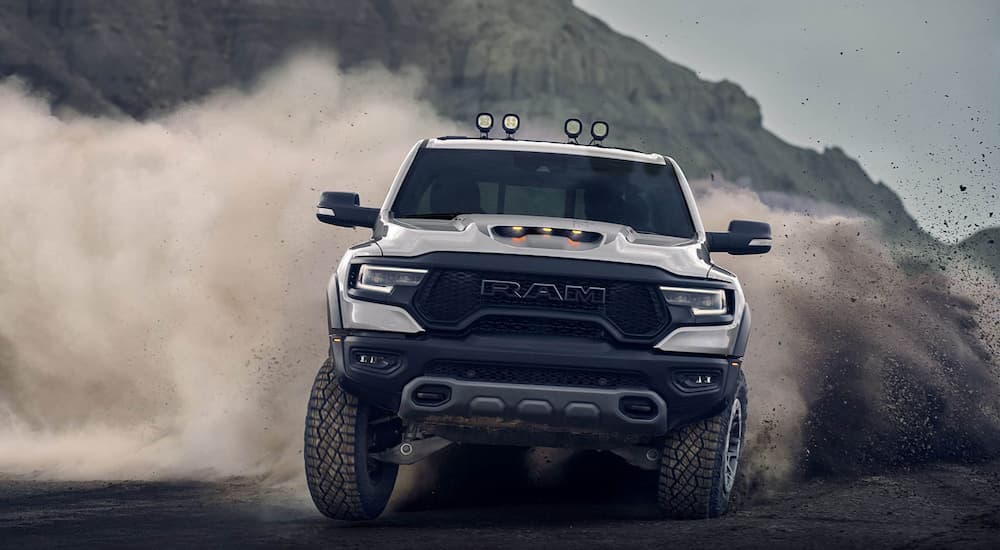
Your search for a New Jersey Ram 1500 dealership might have been inspired by an iconic workhorse like the Ram 1500, but do you know the secret behind the Ram 1500’s capability? You might immediately think of the old television ad asking, “That thing got a HEMI?” However, there’s more to the Ram 1500’s capability than its heartbeat. We’re talking about Ram’s unique TorqueFlite transmission.
Before diving into what makes Ram’s TorqueFlite eight-speed automatic transmission so impressive, it’s only fair to start with what a transmission does and how it works. Otherwise, it’s nothing but gibberish that does little for your search for the perfect Ram 1500. So, what exactly does a transmission do? And more specifically, what’s unique about the TorqueFlite transmission that’s been around since the 1950s? As your Ram authority, we’re here to answer those questions and more.
Transmissions 101
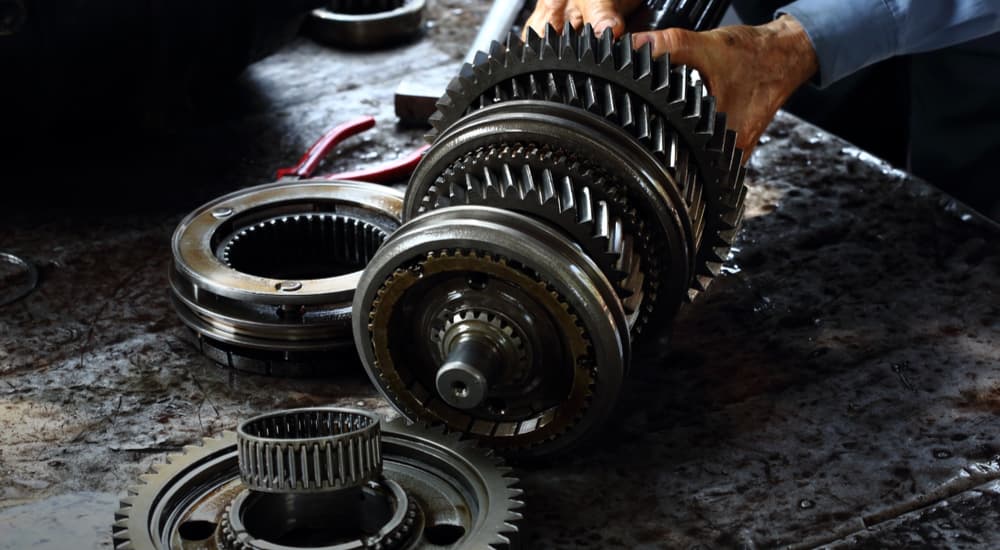
Understanding how a transmission works starts with knowing more about how an engine operates. First, the fuel ignites in the engine’s combustion chamber and causes gas and heat to expand in a miniature explosion. This explosion forces the pistons within the engine’s cylinders to move up and down, spinning the engine’s crankshaft with each movement. Then, as the crankshaft rotates, it turns the drive wheels and transforms the initial explosive energy into mechanical energy that propels your vehicle.
The many moving components of the engine make its operation loud and extremely hot. The transmission works like a safeguard for your engine, almost akin to keeping a leash on your dog to prevent it from running away. What do we mean? The transmission ensures the engine spins at the correct rate based on how much or how little you engage the accelerator pedal. Without the transmission, your engine would spin too fast, consuming excessive fuel and eventually vibrating itself into overexertion or overheating.
Transmissions harness the engine’s power and capability by using a range of gears, like the TorqueFlite eight-speed automatic transmission with its eight gears. An automatic transmission selects the appropriate gear based on your acceleration, shifting into a higher gear with increased speed. In contrast, manual transmissions require a little more input since you must engage the clutch at the appropriate time and shift into the correct gear. This rhythm between engaging the clutch and shifting gears provides a physical connection to the vehicle and is eventually learned by the feel and sound of the engine. For example, you’ll hear the engine struggle and feel the vehicle slow down at higher speeds when it’s time to switch to a higher gear.
Meet the Torqueflite Transmission
The TorqueFlite transmission has been a staple in the Chrysler lineup since the 1950s when Chrysler models were renowned for their three-speed transmissions that delivered smooth shifting and impressive longevity. Before long, the TorqueFlite built a reputation for being the best automatic transmission in the world. Variants of the TorqueFlite, like the A-727, were soon worldwide standards. The A-727 was praised for its lightweight design, making it ideal for drag racers, monster trucks, and off-road rigs. It even made its way under the hood of V8-powered sedans and heavy-duty workhorses, where its brute strength and reliability earned it high praise across the board.
Over the years, the TorqueFlite transmission only improved with time, especially in 2011 when Chrysler made headlines with the introduction of the first eight-speed automatic transmission produced on American soil. The TorqueFlite eight-speed was mated exclusively to Chrysler’s award-winning 3.6L Pentastar V6 engine on the 2012 Chrysler 300 and 2012 Dodge Charger, a welcome replacement to the five-speed automatic transmission in both models. So, what made the eight-speed TorqueFlite so revolutionary at the time?
Until 2011, eight-speed automatic transmissions were only found on high-end luxury vehicles from Rolls Royce, Range Rover, and Bentley. They weren’t readily available on your typical American car, especially not a Chrysler or Dodge. However, that changed in 2011 and gave Chrysler, Dodge, Ram, etc., a stronger foothold in the industry with the ability to deliver exceptional power and efficiency without making any structural changes to the current lineup. With fuel economy increased by 5% and emissions reduced by 11%, it was a win-win for everyone.
The TorqueFlite Impact
In 2014, Chrysler Group celebrated the inclusion of the TorqueFlite transmission in over one million vehicles worldwide by announcing its impact. Over three years, the eight-speed TorqueFlite transmission saved over 700 million gallons of fuel for a total savings of $2.5 billion for Chrysler Group customers. In addition, the transmission also reduced emissions by over six million metric tons, positively impacting the environment and reducing Chrysler Group’s and its customers’ carbon footprint.
The Latest TorqueFlite Transmissions
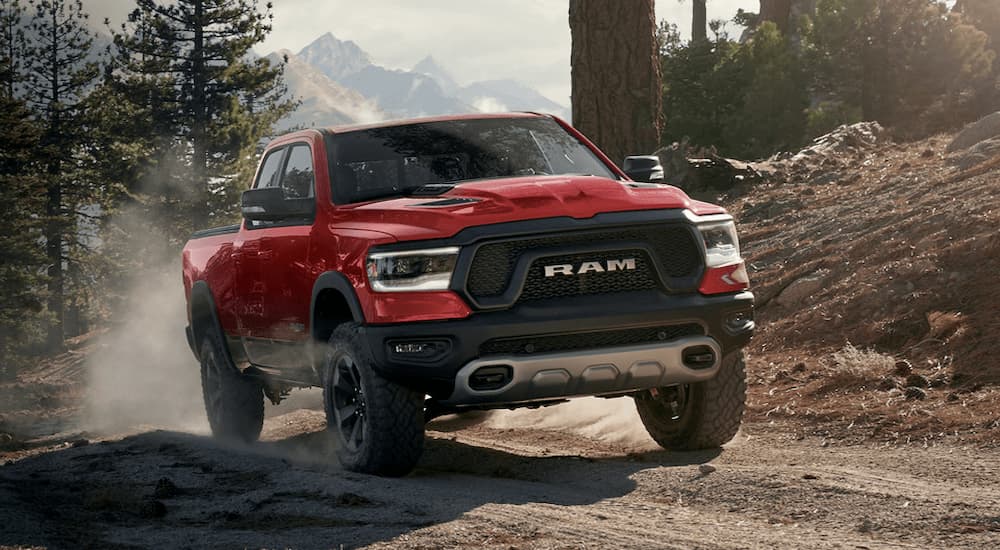
Ram introduced the latest generation of the eight-speed TorqueFlite transmission on the 2019 Ram 1500, which continues with the 2022 lineup. Ram trucks with the award-winning 3.6L Pentastar V6 rely on a TorqueFlite 850RE transmission. Models outfitted with the 5.7L V8 HEMI or the 6.2L supercharged HEMI V8 SRT (Ram 1500 TRX) come equipped with the TorqueFlite 8HP75 transmission. Both transmissions offer an excellent balance of power and efficiency, with the 8HP75 delivering a higher torque capacity for quick, crisp gear changes you’d expect of a heavy-duty workhorse or a speed demon like the TRX.
The next-generation TorqueFlite transmission introduced a new era of technology that allows the transmission to process data from the engine faster, generating a seamless response. The technology works with Ram’s eTorque mild hybrid system and relies on a shift-on-the-fly capability that enables the transmission to shift gears immediately based on accelerator feedback. But what does shift-on-the-fly mean in terms of mechanics?
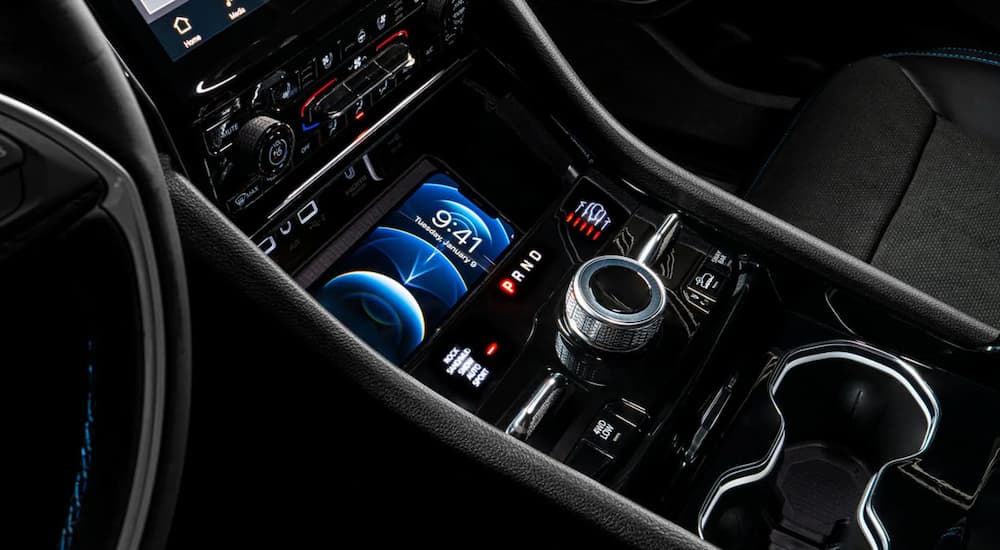
Automatic transmissions traditionally rely on the mechanical linkage between the gear shift lever and transmission. The TorqueFlite transmission replaces these mechanical links, optimizing space and delivering effortless shift patterns by engaging a button or turning a knob. The result is immediate responsiveness, optimizing the engine’s performance at any speed or condition and giving drivers more control over the truck’s performance.
The transmission’s responsiveness is also a direct reflection of its 40 individual shift maps. This shifting strategy accounts for variables like hills, speed control, engagement of the electronic stability control feature, engine temperature, acceleration, gear downshifts, and changes in engine torque. This strategy means the transmission constantly evaluates the situation and the engine’s operation to ensure you have the power you need exactly when you need it.
What Torqueflite Means for You
Chrysler’s TorqueFlite transmission is legendary in the automotive industry, proving that drivers can enjoy power and performance without excessive fuel consumption. The debut of the eight-speed TorqueFlite automatic transmission in 2011 took Chrysler and its sibling brands to the next level by making a transmission that was once only available in luxury brands now accessible to the masses. So, what was the result? Tremendous savings and legendary performance.
Today, your search for a Ram 1500 truck guarantees you’ll reap the benefits of the TorqueFlite transmission. By design, the TorqueFlite’s wide gear range delivers almost imperceptible gear changes, optimizes performance, and reduces overall fuel consumption and emissions. With Chrysler reporting the TorqueFlite transmission saved customers over $2.5 billion in fuel between 2011 and 2014, you can only imagine the savings after a decade and what that will mean for you once you’re behind the wheel of a legend like the Ram 1500.
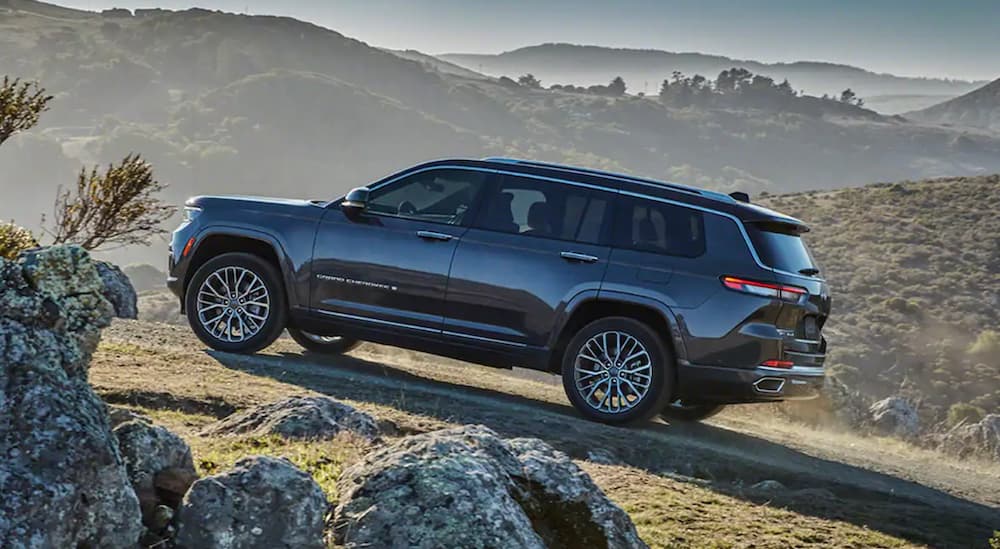
Jeep recently threw its hat into the ring of manufacturers offering three-row vehicles with its all-new Grand Cherokee L. For loyal fans of Grand Cherokee who need room for a few extra passengers, this is exciting news. And with the L offering a starting MSRP that’s only marginally more expensive than the classic Grand Cherokee, this new addition to this legacy lineup has certainly piqued the interest of many drivers. As one of our neighborhood’s most trusted New Jersey Jeep dealers, we’ve had many customers come in with questions about what exactly differentiates these two vehicles.
Jeep recognized that lovers of the Grand Cherokee are used to a certain suite of features and quality of materials. They also knew that the Cherokee, in all its varieties, is for the adventurer. You’ll still find that original spirit in the L. In fact, almost everything you already loved about the classic variety can be found in the L. However, there are a few differences to note before you begin your shopping process. So let’s dive in and see what’s different (and the same) about the Jeep Grand Cherokee L.
What’s the Same?
First, let’s get a brief overview of what you can find standard across both of these impressive vehicles. We know there are some features that are a must-have for a Grand Cherokee driver, and we want to assure you that those are still there.
For starters, you can rely on enjoying available massage front seats in both the Grand Cherokee and the Grand Cherokee L, so drivers needing a little lower back relief on long drives can find it in either of these options. You’ll also still find either cloth or leather upholstery options in both of these vehicles, along with beautiful wood paneling. Sitting in the front driver or passenger seat of either of these vehicles, you won’t notice much of an aesthetic difference. Moving to the outside, you’ll find the same monotone color options, too – earth tones that are perfect for this outdoorsy vehicle.
As for capability, you’ll still see available 4×2 or 4×4 drive on either car. So those wanting to take this thing off-roading can opt for a car that will send torque to all four wheels with a 4×4 option. Speaking of off-roading, both the Grand Cherokee and the Grand Cherokee L still offer the signature available Selec-Terrain Traction Management System with multiple modes from auto to sport to mud to snow to rock, making either choice great for rugged terrain.
As for technology, both vehicles offer the Uconnect 5 with a 10.1-inch touch screen that allows for up to five driver profiles and dual phone connectivity, giving multiple users the chance to customize their experience through apps, displaying data, and more. They both additionally come with TomTom navigation for useful information like up-to-date traffic and weather reports and even parking information, as well as alerts on local speed limits and speed-camera locations.
What’s Different on the Inside?
Seating and Dimensions
We know the L has three rows of seats, so that’s an obvious interior difference. It should be noted that the L can come with six seats without a console, six seats with a console, or seven seats, so there are several options here for passenger capacity. Additionally, the Grand Cherokee L has a sliding second row of seats allowing for over seven inches of adjustment, which makes it quite comfortable for tall riders. This sliding row also makes it easy for passengers to get all the way to the back row without having to climb over the second row (a common concern in three-row SUVs).
The added third row is going to naturally mean a longer vehicle overall. And it’s true: the L is over 10 feet longer than the standard Grand Cherokee, with the L stretching to 204.9 feet long and the traditional variety at just 193.5 feet. So, it’s a lot more car to manage.
Cargo
The L is going to offer much more cargo space than the traditional Grand Cherokee because of its third row. In fact, you can see a max carbo space of 84.6 cubic feet in the Grand Cherokee L with the back seats folded down, compared to just 70.8 cubic feet of max storage space in the standard Grand Cherokee. This is great news for those who don’t necessarily need to cart around six or seven passengers at all times but do need to carry large items like snowboards or other hefty gear.
What’s Different on the Outside?
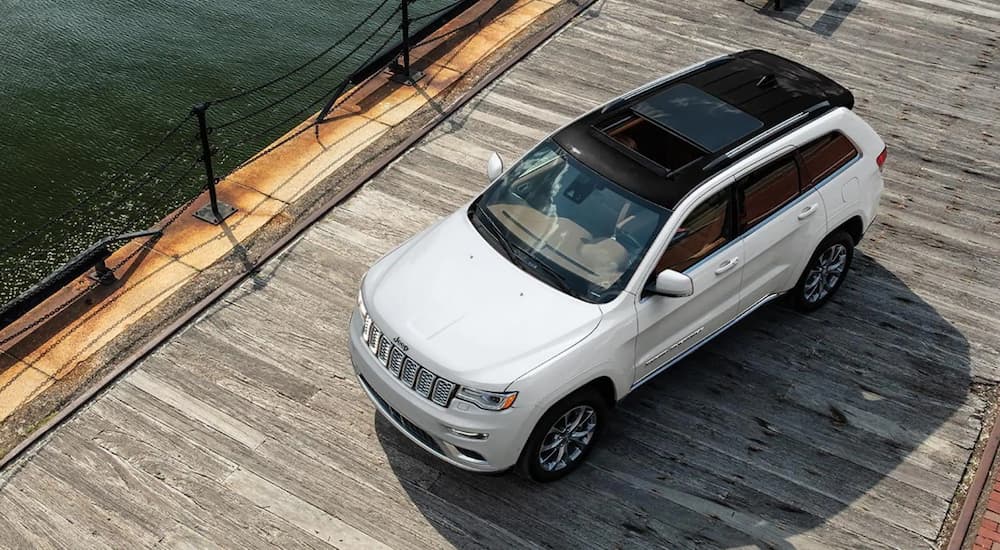
The new Grand Cherokee L has a wheelbase that’s a good five feet longer than the standard Grand Cherokee. Traditionally, a longer wheelbase is going to offer more stability but slightly more difficult maneuverability. However, there’s an advantage of the overall larger size of the Grand Cherokee L: it has nearly 300 more pounds of curb weight compared to the traditional Grand Cherokee. More curb weight can mean more momentum and potentially less damage in the event of a collision. Lighter vehicles tend to weather worse damage in collisions with heavier vehicles.
Trims
The Grand Cherokee and the Grand Cherokee L come in nearly all of the same trims, with a slight variance. The Grand Cherokee comes in the Laredo, Altitude, Limited, Trailhawk, Overland, Summit, and Summit Reserve. Meanwhile, though the Grand Cherokee L comes in most of those trims, it doesn’t offer a Trailhawk variety, nor does it come in a plug-in hybrid (yet). We’re still not sure whether or not Jeep will offer the L in those models. The benefit of the plug-in, of course, would be fuel economy and savings at the pump overall. Meanwhile, the Trailhawk offers an impressive 11.3 inches of ground clearance, compared to the max 10.9 inches offered on the L trims. Both models are great for off-roading; however, those needing plenty of space between the bottom of the vehicle and the ground will only get that in the standard Trailhawk.
A Different Shape
If you look closely, you’ll notice some contouring on the top of the Grand Cherokee L that isn’t found on the standard Grand Cherokee. This allows for slightly better aerodynamics and a sleeker aesthetic. But the difference is mild.
If You Need Three Rows, Get the Grand Cherokee L
All in all, important interior and exterior features remain very similar between the Grand Cherokee and the Grand Cherokee L. The biggest difference here will be the third row, which can mean seating for up to six or seven passengers. If you can’t fit everyone in the standard Grand Cherokee, you can rest assured that you’ll feel right at home in the L and notice little difference.
Of course, there is that added cargo space in the L, too, which you’ll need if all of those extra passengers are packing extra stuff. And the second sliding row offers some nice customization not found in the standard Grand Cherokee.
You will also miss out on the Trailhawk if you opt for the L. However, off-roading might not be a priority for those needing to transport seven passengers, so Jeep might have understood their customer base here when selecting trim options for the Grand Cherokee L. When you’re ready to test out these two vehicles for yourself, we at Spirit CDJR are excited to show you the ins and outs of each model.
Our 10 Favorite Features of the Grand Wagoneer
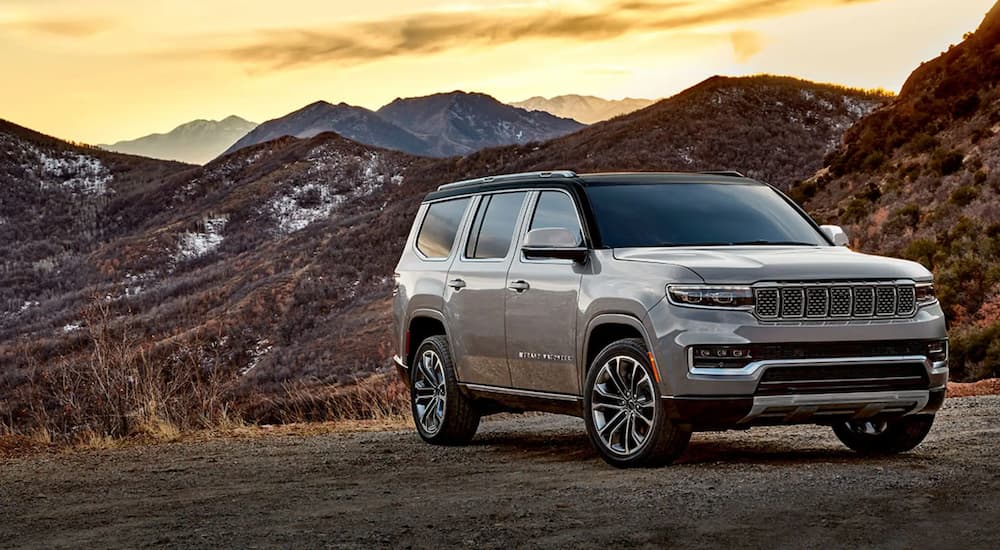
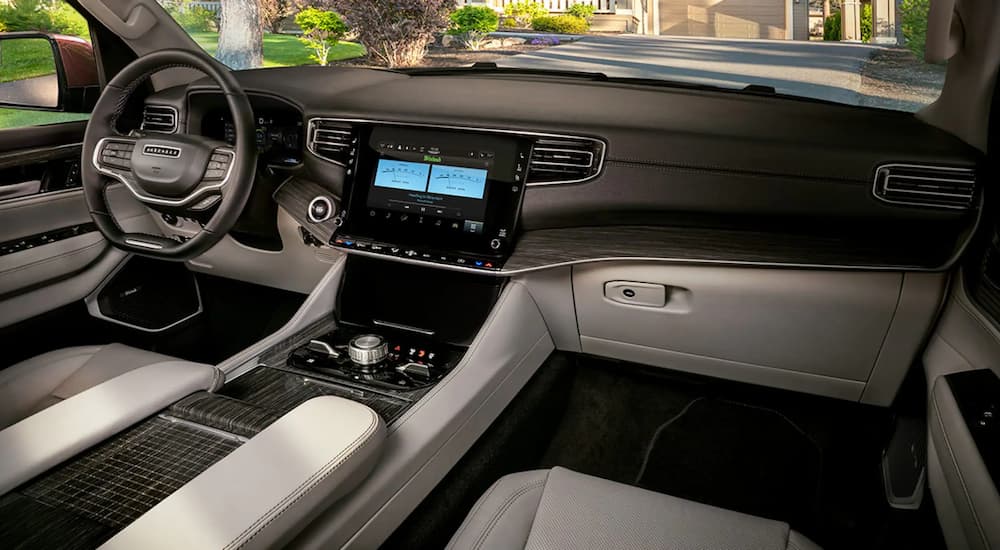
The level of extravagance that resides in the Grand Wagoneer is undeniably unmatched, and if you’re searching for refinement like never before, you’ll find it in this prestigious model. At Spirit CDJR, we’re the top NJ Grand Wagoneer dealer, and if you desire unparalleled luxury, you’re sure to find it with this upscale full-size SUV. From its perfectly appointed interior to its alluring and rugged exterior, pronounced Wagoneer grille to its dazzling LED taillamps, the Grand Wagoneer is designed with high-end sophistication at its core. When it comes to our favorite features about the Grand Wagoneer, although we could go on for hours about how alarmingly impressive it is, we’ve managed to narrow it down to a few of the absolute can’t-miss elements in this luxurious vehicle.
1. Hand-Crafted Appointments
Stepping inside the palatial cabin of the Grand Wagoneer seems as though you’re entering into another dimension of sophistication. A leather-trimmed console and doors pair perfectly with American walnut and authentic metal accents to make for a grandeur that is simply untouchable. It’s all in the details with this opulent machine, and you’ll find that its suede headliner and pillars add just the right amount of elaborate comfort to this pristine SUV. Plus, with 24-way power-adjustable and massaging front seats, sinking into the feeling of the drive is effortless, allowing you to be transported to a new level of euphoria inside the Grand Wagoneer.
2. Quadra-Lift Air Suspension
Its posh cabin space is accentuated by a ride like no other, with Quadra-Lift Air Suspension at your service to deliver the most comfortable ride in the industry. The Grand Wagoneer is built to handle the elements, and whether you’re trekking through the forest or on the open highway, you’ll be in for an immaculate ride. This electronically controlled suspension system showcases unparalleled precision on any surface. With specially tuned shocks to absorb the bumps of the road, all you’ll feel is absolute comfort inside this remarkable machine. Raising or lowering the Grand Wagoneer to account for the terrain that resides beneath its tires, the Quadra-Lift Air Suspension system is quite unlike anything you’ve ever experienced before.
3. Best-In-Class Towing
In addition to being incomparably beautiful, the Grand Wagoneer is exceptionally strong, showcasing some impressive best-in-class accolades that don’t go unnoticed by its competitors. The Grand Wagoneer is armed with a powerful 6.4L Hemi V8 engine that delivers 470 horsepower to provide a spirited ride and 455 lb-ft of torque to allow it to tow more than any other vehicle in its class. Able to handle up to 9,850 lbs when properly equipped, the Grand Wagoneer solidifies its spot among the most talented SUVs in the industry. Perfect to haul your camper out for a weekend adventure or transport your prized Thoroughbred to its next event, the Grand Wagoneer has the strength to handle anything.
4. Best-In-Class Cargo & Passenger Volume
Among the beauty that resides inside its plush cabin, the Grand Wagoneer also offers a spaciousness like no other. With seating for eight and three rows of space, the Grand Wagoneer provides passengers with class-leading second and third-row legroom to maximize the experience inside. Plus, with its power-folding third-row bench seat, you’ll get to enjoy best-in-class cargo volume behind the third row, allowing you to perfectly accommodate everything accompanying you on your journey. From 60/40 split-folding seats to a variety of storage cubbies throughout, there won’t be a question of whether or not you can fit everything inside this impressive vehicle.
5. Serious Off-Road Talent
Don’t be fooled by the abundance of high-end style that emanates around the Grand Wagoneer; it’s a skilled off-road machine through and through. Its Quadra-Drive II 4×4 System showcases elements like a rear electronic limited-slip differential to maximize its agility on some of the toughest terrains. A Selec-Terrain Traction Management System adjusts for changing road conditions to provide a heightened level of control and stability, no matter where you’re traveling. Plus, with an active two-speed transfer case with Selec-Speed Control, the Grand Wagoneer automatically switches between two low-end power modes for when you need more power to plow through your obstacles.
6. A Stylish Exterior
The Grand Wagoneer will capture your attention from the moment you cast a glance at it, with a commanding presence of undeniable sophistication that’s quite unlike any other vehicle on the road. Dazzling color-tinted glass amplifies the Grand Wagoneer’s style, while a tri-pane panoramic sunroof provides brilliant views of the skies above. Sparkling LED lighting not only adds an enhanced level of functionality to the Grand Wagoneer, it also elevates its style to new heights. Carefully designed and executed with class, the Grand Wagoneer makes a serious statement in the industry, further propelling itself to the front of the line when it comes to luxury vehicles.
7. Class-Exclusive Displays
With 75 inches of display screens dotting its distinguished interior, the Grand Wagoneer proves that there’s no shortage of technology inside. Perhaps what’s most impressive is its available class-exclusive 10.25-inch interactive passenger display, providing multiple ways for your passengers to enjoy their ride to the fullest. From trip information to entertainment, your passengers will be able to take advantage of a more comfortable travel experience. You’ll also find a rear-seat entertainment system through two available 10.1-inch displays to keep backseat passengers entertained even on long road trips. No matter where you’re seated in the Grand Wagoneer, you can expect to be provided with the very best technology in the industry.
8. Over 120 Standard & Available Safety Features
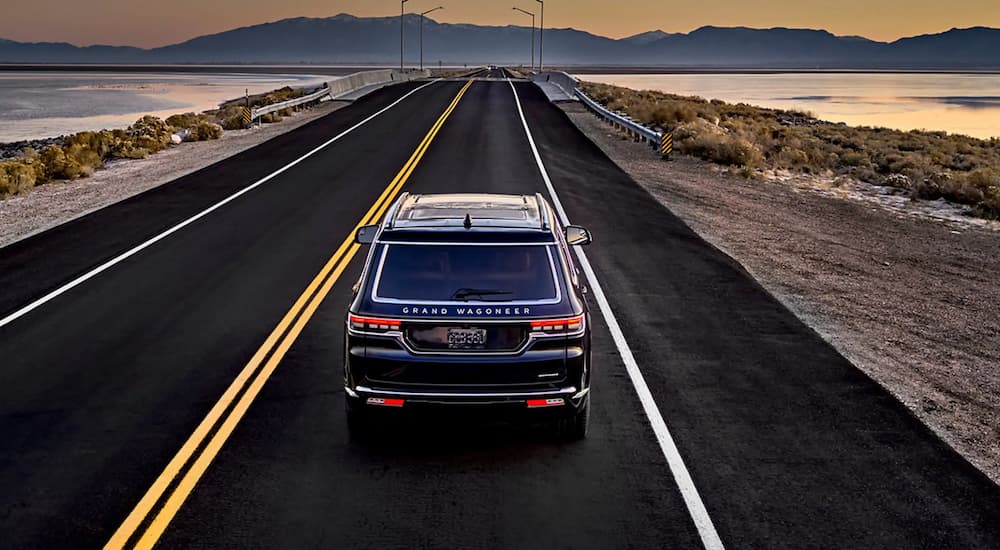
To say that you’re protected on the road and beyond is a given in the Grand Wagoneer through some of the most groundbreaking tech offerings in the industry. From lane-departure alerts to collision mitigation, parking sensors to pedestrian detection, your Grand Wagoneer is constantly watching out for you and those around you during your travels. A Night Vision Camera with Pedestrian and Animal Detection is also available to help you see better at night and in areas with limited visibility through thermal imaging technology. Whether you’re traveling in the middle of the afternoon or the middle of the night, rest assured that your Grand Wagoneer will keep you safe and alert.
9. Cutting-Edge Cameras
Heightened visibility in front of you, behind you, and all around you can be expected in the Grand Wagoneer with a series of state-of-the-art cameras. From a 360-degree Surround View Camera to provide a view around your vehicle to an Interior Rear Monitoring Camera to watch over your passengers, the Grand Wagoneer offers what you need in a vehicle. You’ll also find a Digital Rear View Mirror available, which projects a real-time video stream of what resides behind your vehicle so that you’re able to avoid obstacles efficiently.
10. Autonomous Driving Capabilities
Last but certainly not least, when you need an extra pair of hands on the road, the Grand Wagoneer steps in to be your ultimate co-pilot. Through Active Drive Assist, you’ll be able to take advantage of hands-on automated driving capabilities to enhance the safety and comfort of your drive. Utilizing Adaptive Cruise Control with Stop and Go, coupled with lane-centering technology, your Grand Wagoneer is able to keep you moving forward safely through traffic, allowing you to get to where you’re going with ease. When you’re looking for some extra help with your drive, the Grand Wagoneer is ready to be of assistance.
The Ultimate Experience in the Grand Wagoneer
No matter where you’re traveling, who you’re traveling with, and what tasks you need to complete on your journey, the Grand Wagoneer proves that it can handle it. This upscale vehicle certainly has it all, from dashing good looks to incomparable driving dynamics and cutting-edge technology to a presence that leaves admirers staring in awe. When it’s time to drive a vehicle that showcases a level of excellence that you can’t find elsewhere, it’s time to schedule a test drive with Spirit CDJR and experience this fine machine in action. Once you drive this alluring model, we can guarantee that your travels will never be the same again.
The Wagoneer: A Legacy of Luxury and Unique Style
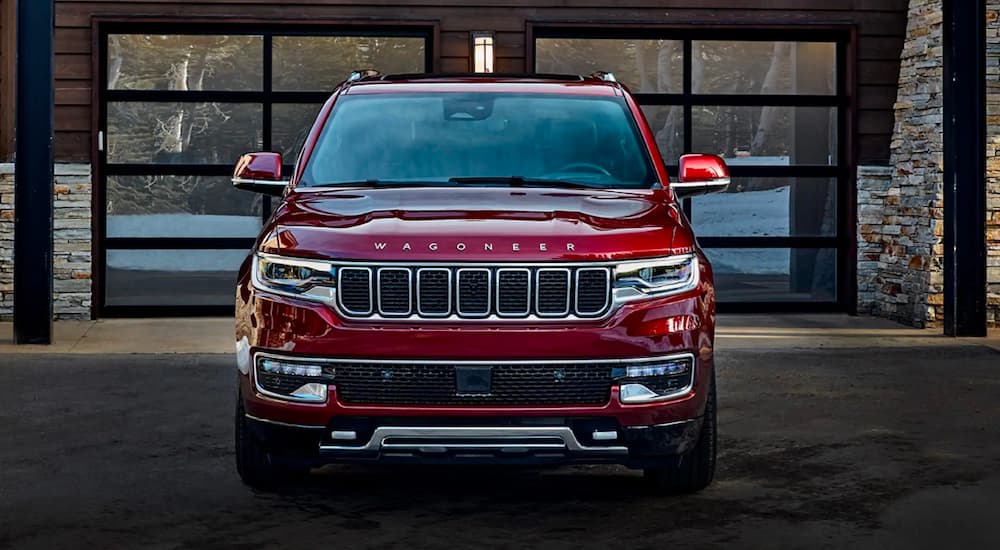
While the Jeep brand originated in the 1940s, it was the 1960s that brought about significant innovation to the company. It was one Jeep designer who chose to focus on designing a vehicle for family travel that could go anywhere, just like the rest of the Jeep family. As Jeeps were being driven on the other side of the world for military duties, a new Jeep designed for comfort and outdoor excursions was being developed. Here, we will share the history of the original Wagoneer to encourage appreciation for the new Wagoneer models now available at your NJ Wagoneer dealership.
The First Decade
When the first Wagoneer was designed and produced, Jeep was owned by Kaiser Jeep Corporation. The Wagoneer’s first arrival on the automotive scene was in 1963, a product of the idea that Jeep wanted to build a family-oriented vehicle. Origins of the Wagoneer erupted out of the notion that a station wagon would be the direction Jeep would take to replace an old pre-war model; however, designer Brooks Stevens took the Wagoneer toward a loftier goal of luxurious sport utility. Thus, the Wagoneer was birthed amongst its more austere brethren of the day—a marked contrast of comfortable, fashionable, and car-like drivability that made it instantly successful.
For eight years, not even the Range Rover could compete with the uniquely-designed Wagoneer, which featured amenities like power steering and brakes, a radio, and optional air conditioning. The independent front suspension contributed to less truck-like ride quality, yet it still had the chops to tow and haul like a truck, a first for four-wheel drive vehicles at the time. With the incredible response to the Wagoneer’s sales, Kaiser developed the Super Wagoneer in 1966. This Jeep took the Wagoneer to an even grander height of luxury, with features like a push-button radio, standard air conditioning, a powered tailgate, and an automatic transmission.
AMC Ownership
The Super Wagoneer was produced for three model years until American Motors Corporation (AMC) bought out Kaiser in 1970. Changes were made in the lineup, and the former Super Wagoneer was placed on the back burner until it became the Limited trim in 1978. With a higher asking price justified by even more cutting-edge conveniences like powered seats, leather upholstery, and carpeting on the floors, it was at this point that the Wagoneer began to sport its now iconic wood-paneled siding. It also continued to refine the truck chassis to reduce noise in the cabin and further smooth the ride to make it a plush outdoor adventure vehicle for upscale travel.
In the midst of all the changes to the Jeep lineup, AMC developed the Quadra-Trac 4×4 system, which allowed for full-time four-wheel drive capability without having to deal with a transfer case. AMC tested out the Quadra-Trac system on other Jeep models like the Cherokee and Jeepster through the 70s, and then added it to the Wagoneer Limited when it was introduced. For all the years of its production, the Wagoneer held fast to its rather classic design, and then in 1979 AMC made a bold move to change the front end with one-piece bumpers and a new plastic grille. This front fascia became the face of the Wagoneer for several years until it was updated in 1985.
Eventually, AMC decided to take the Limited into fresh territory in response to the exceptional sales from the continued additions of modern conveniences. 1984 ushered in the Grand Wagoneer nameplate with a number of scrambled body styles within the Wagoneer and Cherokee designs, a confusing mixture of an attempt to update the old SJ body of the traditional Wagoneer to start offering it on the more compact XJ platform. AMC even introduced a Wagoneer Custom trim on the XJ as a less expensive option in 1984, sans the woodgrain siding and with part-time four-wheel drive, but it was dropped after one year due to low sales. After the numerous shifts within the Wagoneer lineup proved unsuccessful, the SJ platform remained the standard until it ended production.
Chrysler Takes the Cake
One final update of the Wagoneer took place under AMC in 1986 with little change to the exterior; most of the changes were interior updates to the climate controls, instrument cluster, and headrests to bring the design forward. When Chrysler bought AMC in 1987, it marked the Wagoneer’s 25th year of production. It continued to be a very profitable enterprise within the Jeep brand offerings, even as it aged on the old SJ platform, and some enthusiasts might argue the Wagoneer saw its best years from 1988 to 1991. Though few changes were made to the design, numerous upgrades were added to the SUV that increased its value and desirability.
One such implementation was Chrysler’s choice to utilize an electrocoat paint which was applied in two stages, making the Wagoneer less prone to rusting. Updates to the air conditioning and wipers were welcome changes to improve their quality, and then a new overhead console made space for sunglasses storage and housed a new keyless entry system. Throughout its final years of production, Chrysler left the Wagoneer to its familiar design, still loved by those who staunchly enjoyed its comforts for cruising on the highway despite its thirsty engine. By 1991, the Wagoneer’s final model year, it still rode on that same original platform designed by Brooks Stevens, but new federal regulations would have been too costly to reconfigure the design to comply with the law.
End of an Era?
After the end of Wagoneer production, Jeep revived its old nameplate for one more year. The longest-running nameplate for a single platform was restored within the Grand Cherokee lineup as the uppermost trim level in 1993. In keeping with the Grand Wagoneer tradition, the woodgrain siding made it immediately recognizable and focused on top-tier features. Chrysler only offered this as a one-year special edition before retiring the nameplate for good. Or so it seemed. Almost two decades later, Chrysler CEO Sergio Marchionne announced in 2011 that the Grand Wagoneer was to be reborn as a seven-passenger SUV for 2013, but the year came and went without a new design reveal.
In 2014, Chrysler said the Grand Wagoneer was slated for production beginning in 2018, but it took until 2020 for the new Grand Wagoneer to be revealed as a concept before its production in the 2021 model year restoring both the Wagoneer and Grand Wagoneer nameplates at the same time. Instead of the announced seven-passenger SUV, Jeep built the interior to hold up to eight people, with the option to upgrade to second-row captain’s chairs which could be heated, ventilated, and reclined. As with past years, the new models upheld the luxe standards of the original Wagoneer with the utmost attention given to modern features of convenience and comfort.
Revived for a New Generation
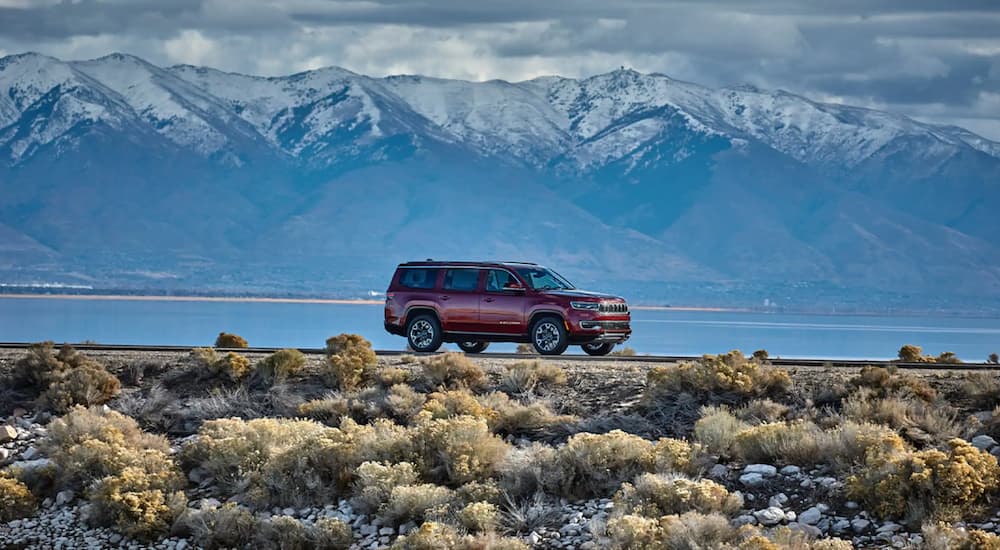
2022 Wagoneer and Grand Wagoneer models are bringing back some of the aspects of the original SUV, particularly in terms of ride quality and luxury. The body shape honors the former SJ platform styling, with nods to the original greenhouse windows for wide-open views, the somewhat blocky exterior, and the lines in the hood. For the most part, however, the original Wagoneer served simply as an inspiration for a whole new generation of luxury that fits more closely into the branding Jeep now embraces. While the past Wagoneer models have been retired, there are still those few that were well-maintained and are still being driven.
On occasion, a classic Wagoneer can be seen in movies, its unmistakable grille tilted forward and its wooden siding standing out from a crowd. Past models have been rebuilt with new engines or have replaced the brakes, ignition, or the muffler to keep the still-sturdy body on the road. Though the new generation offers up the modern lifestyle conveniences of better fuel efficiency, more ergonomic seats, and smartphone connectivity, the Wagoneer’s roots run deep in the Jeep community. Those who still own an original Wagoneer hold fast to nostalgia for the old days when a design was so good it could last for almost three decades.
Electrify Your Adventure with the 2022 Wrangler 4xe
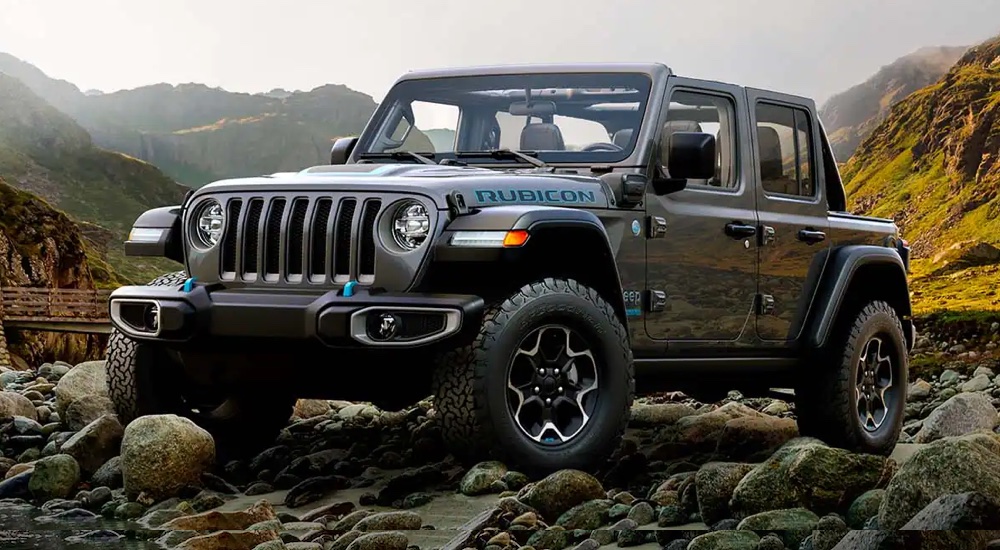
Are you ready to adopt an all-electric lifestyle but worry about having to sacrifice your sense of adventure both on and off the pavement? There’s a touch of irony in the electric vehicle segment as the people who are extraordinarily passionate about the great outdoors aren’t yet confident in electrifying their adventures with a hybrid or all-electric powertrain. How can they rely on a battery-powered vehicle in the middle of nowhere? As your NJ Jeep Wrangler dealer, we’ve got the answer right here on our lot––the 2022 Jeep Wrangler 4xe.
The 2022 Wrangler 4xe proves that you don’t have to make any sacrifices when it comes to electrifying your future both on and off the trail. Instead, Jeep challenges you to “plug into adventure” in the 4xe, a plug-in hybrid that delivers the legendary capability of the Jeep name with remarkable efficiency and the same Wrangler style. It’s the future of trail runners, and lucky for us, the future is now.
Explore with Confidence: Hybrid Power
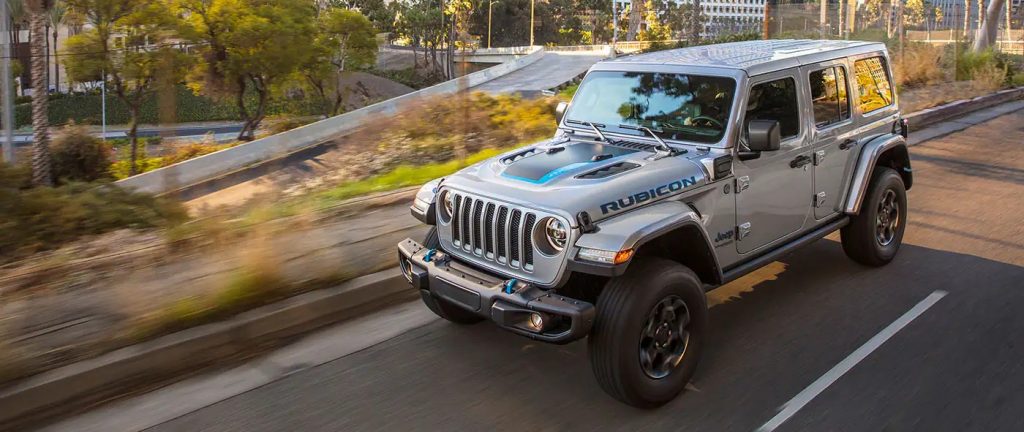
The 2022 Wrangler 4xe is powered by a 2.0-liter turbocharged four-cylinder engine, dual electric motors, and a 400-volt lithium-ion battery pack. Mated to a TorqueFlite eight-speed automatic transmission, this hybrid power generates 375 horsepower and 470 lb-ft of near-instant torque for exceptional acceleration on any terrain. For the sake of comparison, the 2022 Wrangler 392 has a 6.4-liter HEMI V8 engine under its hood and churns out the same amount of torque, and has the same 3,500-pound tow rating.
One of the biggest concerns of electrifying an off-road warrior like the Wrangler is the vulnerability of the hybrid powertrain when the Wrangler is in its natural element and crossing a body of water. Jeep truly thought of everything and sealed the battery pack and the other electronics in a waterproof case that protects the components in up to 30 inches of water. This gives you the confidence to answer the call of the wild, even if it means getting your feet (or wheels) wet.
Venture Farther from Home: Hybrid Efficiency
Using both gas and electric power, the Wrangler 4xe gives you the confidence to venture farther from home. The 4xe’s hybrid powertrain delivers an electric fuel economy of 49 MPGe, a gas fuel economy of 20 MPG combined, and a combined driving range of 370 miles. As with any vehicle, these numbers will vary based on the terrain and your driving style.
Jeep gives you more control over the Wrangler 4xe’s performance and efficiency with E-Selec drive modes. The Wrangler 4xe’s default mode is Hybrid, which gives you the best of both worlds by using power from the 2.0-liter turbocharged engine and the dual electric motors. With electric power used first, you can extend the 4xe’s range without sacrificing capability since the mode delivers instant torque and maximum horsepower for immediate acceleration.
You can maximize efficiency on your daily commute by switching the 4xe into Electric Mode. In this mode, the 4xe relies solely on battery power while still delivering the maximum amount of horsepower and torque. This makes Electric Mode a great option even on the trail when you want to immerse yourself in nature without stopping. Since it’s only using battery power, the 4xe in Electric Mode is incredibly quiet, but it is more than capable of handling even the most technical terrain.
When you’re faced with a long drive, you’ll want to switch the Wrangler 4xe into eSave Mode. This mode prioritizes the model’s 2.0-liter engine and reserves the battery for later use like in-town driving or shorter distances. Jeep adds a unique feature to the Wrangler 4xe’s eSave mode by shutting the engine off when power demand is low, which boosts the Wrangler’s overall efficiency.
Jeep’s Seal of Approval: Trail Rated and Ready to Explore
Jeep introduced the Trail Rated badge in 2003 as a reflection of its commitment to building models that give drivers the freedom to go anywhere and do anything. With the Trail Rated badge, you know the model has been pushed to its limits and passed every performance test from traction and maneuverability to articulation, ground clearance, and water fording. Today, the Trail Rated badge is just as significant.
Just like every Wrangler, the Wrangler 4xe is Trail Rated and ready to explore. Earning its Trail Rated badge was no easy feat, but the Wrangler 4xe’s many off-road components earned it a coveted place in the Jeep fleet. The Wrangler Rubicon 4xe goes even further and is the first plug-in hybrid electric vehicle in the industry with a front and rear locking differential. This is a vital component to the Rubicon 4xe’s performance on the trail since locking differentials ensure both wheels travel at the same speed to maximize traction even when one wheel loses its grip. The Rubicon 4xe also comes with heavy-duty front and rear Dana axles, a disconnecting front sway bar, and 33-inch all-terrain tires, all of which are responsible for its articulation, maneuverability, ground clearance, and traction.
At the heart of the Rubicon 4xe’s capability is Jeep’s legendary four-wheel-drive system known as Rock-Trac. The full-time four-wheel-drive system delivers more torque so that you have greater control when you’re in the driver’s seat. With a lower, 4:1 transfer case ratio, the system sends more torque to the wheels even at low speeds, making rock crawling a must in this revolutionary Wrangler.
Go Hybrid or Go Home: Charging Made Easy
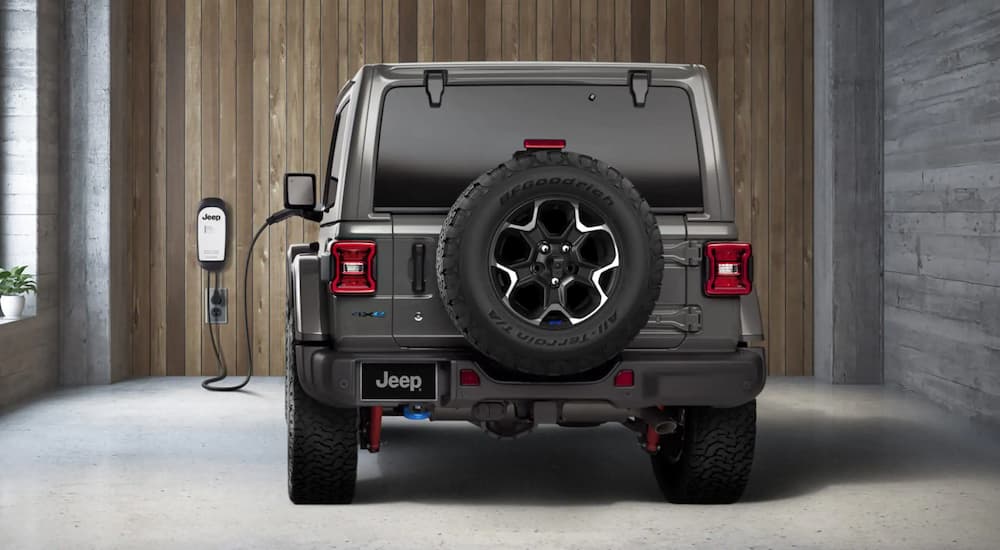
If you’re still on the fence about adding a plug-in hybrid to your garage, Jeep makes it easy to jump off the fence and into the driver’s seat of the Wrangler 4xe. In addition to the model’s E-Selec drive modes, the Wrangler 4xe is equipped with tools like regenerative braking that help you extend the vehicle’s battery life by charging the battery when braking or slowing down. When you engage Max Regeneration, lifting off the accelerator pedal will slow down the vehicle and simultaneously charge the battery.
While tools like regenerative braking are helpful when you’re driving, how easy is it to charge the Wrangler 4xe at home or on the road? More importantly, how can you recharge on the trail? Fortunately, Jeep makes recharging easy wherever you are. Knowing that models like the Wrangler 4xe are destined for the woods, Jeep is installing solar-powered charging stations near some of the most popular trails throughout the country, which allows you to fully charge your plug-in hybrid before getting a little mud on the tires.
When you’re not on the trail, charging the Wrangler 4xe is as easy as plugging it in. Opting for the Level 2 Home Charging Station makes charging more efficient since it can charge the battery up to six times faster than the Level 1 charger. This means less downtime at home and more time for adventures on the trail. The station also gives you more control by letting you schedule when the Wrangler 4xe charges via an app on your smartphone.
Adventure Is Calling, How Will You Answer?
The 2022 Wrangler 4xe is designed for those who love to spend their free time deep in the woods, breathing in the salty air of the New Jersey coast, or navigating mountainside hairpin turns. It’s the legendary Wrangler that we know and love with a modern, greener twist; it’s electrified and, because of that, it’s more versatile than ever. Its hybrid powertrain makes it ideal for in-town driving, while its Jeep name and Trail Rated badge guarantee its capability both on and off the pavement. So, when the wilderness calls, why not plug into adventure in the Wrangler 4xe?
Options! Find Your New, Used, or CPO Vehicle Here

Here at Spirit Chrysler Dodge Jeep Ram, we are a proud carrier of new CDJR vehicles. There is nothing like knowing you’re the first owner of a car, fully responsible for all the wear and tear and upkeep, and seeing that odometer click over its first milestones. You’re the one to set that driver’s seat and first program all your favorite radio stations. But, as your Certified Pre-Owned Chrysler dealer, we also love our used cars!
There are a lot of pre-owned movers with plenty of miles left available for any budget. Our used inventory includes more than just our four base brands, and we’re happy to help you find just the right used ride for you, no matter what make or model. And in the middle of new and used, there are Certified Pre-Owned vehicles. Certified Pre-Owned vehicles go through a stringent inspection process, so you know you’re getting the biggest bang for your budget buck, true new-vehicle quality in a used vehicle. Spirit CDJR is the best Certified Pre-Owned Chrysler dealer in southern New Jersey, and we want to be sure you know exactly why you might want a Certified Pre-Owned vehicle from our family. There are pros and cons to new, used, and Certified Pre-Owned vehicles, and we’re here to talk you through all of them.
New Car Cred
There are a lot of pros when it comes to buying a new car. When you buy a used car, you have to do a lot more research to make sure the one you’re getting isn’t a lemon. This could involve taking the potential new-used car to a mechanic or having to look up the VIN online yourself. Buying a new car, you know it’s in tip-top shape.
If you know what make and model you want, the hardest decision you have is figuring out what color goes best with your eyes. Even if you’re not sold on one particular model, it’s easy to prioritize based on your lifestyle. Do you need the biggest towing capacity or the best gas mileage? Room for a crowd on a road trip or all the tech to stream your favorite playlists on a daily, solo, city commute? It’s so much easier to shop when you’re choosing between makes and not various used versions of the same model, balancing miles on the odometer with available features.
After all, another perk to buying new is that you are sure to have the best of the best safety and tech features. Driver assistance and driver comfort are gaining in leaps and bounds between generations of vehicles and often even between years. Buying a new car means you have the best of what’s available right now. In addition, when you buy a new car, you can expect it to be more reliable. Unless something goes terribly wrong, you’re not going to need to replace the transmission on a new car within the first year of ownership. And if something does go terribly wrong, you have warranties to cover that!

Used Vehicle Values
“They” say that the average new car loses 20% of its value the moment you drive it off the lot – “they” here being a variety of studies. Of course, if you’re buying your new car at Spirit CDJR, you’re getting the best value for that new car, as well as financing that fits your budget. However, depreciation is definitely a thing that happens to all new cars. For this reason, you may prefer to check out the used vehicle options here at Spirit CDJR. After all, depreciation means you can find a well-priced, slightly used car that has all the perks of an almost-new car. This is especially good if you’re looking for particular safety or tech features, like hands-free parking or wireless Apple CarPlay or Android Auto compatibility, wireless smartphone charging, or adaptive cruise control. These are all newer features still found on used cars if you go to the right used car sales specialist – like us. Other reasons to choose a used car include that they cost less to register and insure year over year due to their lower price.
Certified Pre-Owned Paragons
When you want all of the reliability of the newest cars and all of the budget value of used cars, may we introduce you to Certified Pre-Owned vehicles? Certified Pre-Owned – aka CPO – vehicles have gone through a brand-specific certification process. Here at Spirit CDJR, we are proud to carry lots of CPOs thoroughly certified with all of the best perks that come with that.
So what does all of this mean? It means these Chrysler-certified vehicles have gone through a 125-point inspection process. To start, all Chrysler-certified vehicles have to be five years young or younger, with under 75,000 miles on the speedometer. These CPOs also have to have clean titles with no frame damage, and any aftermarket accessories have been proven to not compromise the safety, emissions, or operations of the vehicle. The pre-road testing includes checking all under-hood fluids, from the washer to the power steering. Every single aspect of a CPO Chrysler, Dodge, Jeep, or Ram is verified to be in working order, including the key fobs, wipers, and even the horn. If the CPO you’re looking at has heated seats or a sunroof, you can rest assured they’re in working order as well.
It’s easy for the average buyer to determine if the door locks work or if there are no dents in the bumpers and body panels. A Certified Pre-Owned CDJR vehicle inspection goes even further than that, verifying things you can’t easily see – like that the tires match and are the correct size and offset and that the wheel bolts are torqued to brand spec. All CDJR CPOs also receive thorough detailing, so not only will all of the surfaces be clean, but you’ll get that new car smell, even in a slightly less-than-new car. If the vehicle being certified is missing any paperwork, like, say, the driver’s manual, that will be replaced by the brand, and a CARFAX report is generated.
On top of all the certified and verified operational and visual inspections, buying a Certified Pre-Owned vehicle means that, often, you can get better financing than if you bought a comparable, non-certified used car. Loaners are much more interested in providing financing for a vehicle that has been thoroughly tested and is more likely to stand the tests of time and mileage. Another reason that financing is better for CDJR CPOs is that they come with not just decent warranties off the bat – 3 months/3,000 miles bumper-to-bumper; 7 years/100,000 miles limited powertrain; and 24/7 roadside assistance – but also Certified Warranty Upgrades. These upgrades mean that no matter how long you have your CPO, it will be covered by a warranty!

Options!
Whether you’re looking for a brand-new vehicle or a car that might have some miles on it but plenty of miles still left to go, Spirit CDJR is here for you. On top of all the new Chrysler, Dodge, Jeep, and Ram models available, we also have a wide inventory of used vehicles, so whatever you’re looking for, we can help you find it. And besides all of that new and used goodness, we’re extremely proud to carry Certified Pre-Owned Vehicles. The intense inspection process required for a vehicle to carry the CPO title proves that these vehicles offer the very best of new car bells and whistles but are much closer to a used-car budget.
Once you find your perfect ride, be it new, used, or Certified Pre-Owned, our expert finance team will customize a finance package based on your credit (even if your credit is less than perfect) and budget (even if you’re not looking to have a high monthly payment). Spirit CDJR’s prime location in Swedesboro means that whether you live locally or in Cherry Hill, Philly, or Wilmington, it’s easy to find us, just off the NJ Turnpike. Come see us today for your next new or new-to-you vehicle!
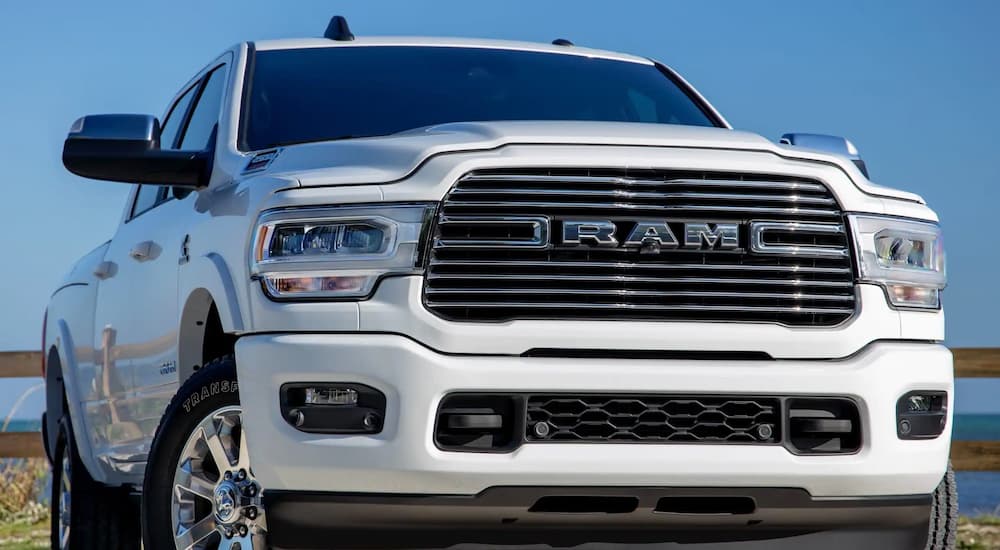
Buying a Certified Pre-Owned (CPO) vehicle comes with a certain peace of mind. Why is that? CPO models have the unique distinction of being used models that receive incredibly detailed inspections and are backed by warranties, so if something goes wrong, your vehicle is covered. As your Certified Pre-Owned Ram dealer, we know a lot about the different things covered under Ram’s CPO warranty, and we want to share that knowledge with you so you can buy with confidence. For example, you might know that a Ram CPO model comes with a 7-year / 100,000-mile Powertrain Limited Warranty, but you may not be aware of all of the elements that the warranty actually covers.
What Does the Ram Warranty Cover?
The 7-year or 100,000-mile warranty for Certified Pre-Owned Rams covers the powertrain and all of its relevant components. That means the engine, the transmission, and the driveline. That goes for everything that is contained within the engine bay, as well as the key mechanisms that propel the vehicle forward and backward, such as the transmission components and the driveline attached to the axles.
More specifically, if you have any sort of serious issues with the vehicle’s powertrain, the warranty ensures that repairs, service, and replacements are covered within the 7-year period or so long as the odometer doesn’t have more than 100,000 miles added to it after the date of purchase. This means that if you have issues with the pumps, anything located within or around the engine block, such as the seals and gasket, the injectors, the ignition, the distributor, or the cylinders, it will be covered by the warranty.
Even issues with the thermostat, timing chain, belts, or manifold would count as being covered by the warranty. The same applies to the transmission. If you have issues with the torque converter, the gear timing, the case, mounts, bearings, the shafts, or the synchronizer, it will be covered by the warranty. Issues with the driveline, such as the driveshaft, the differential, axle housing, or the bearings and joints, are also covered in the warranty.
Any sort of malfunction or part failure from the three major drivetrain components is covered under warranty. So if you buy a Ram and have issues starting it up, notice timing issues with the shifting, or there are problems gaining or maintaining speed, you can have the service done, and you won’t have to pay for it out of pocket. However, keep in mind that there are some things not covered by the warranty.
Does the 100,000 Mile CPO Warranty Cover Routine Service/Maintenance?
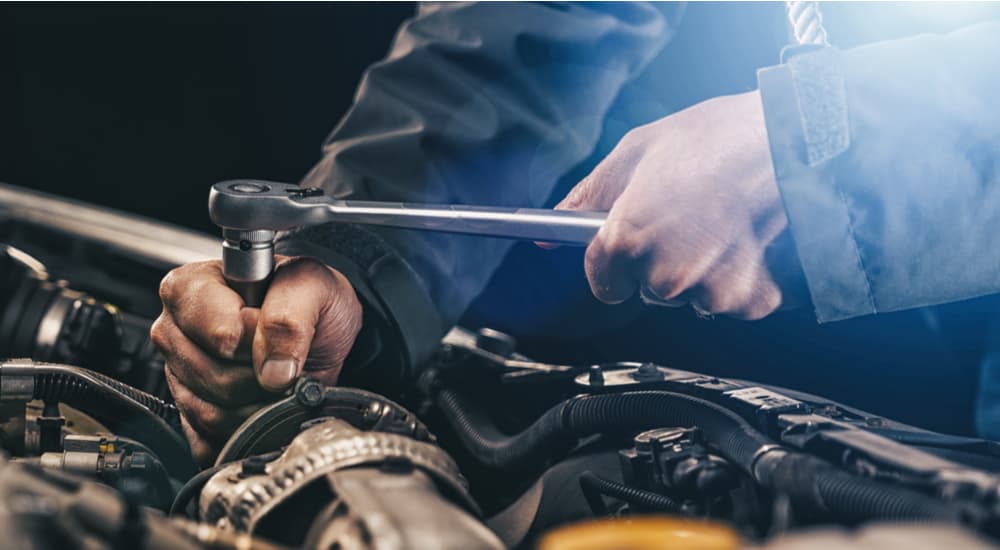
No, the Powertrain Limited Warranty does not cover regularly scheduled maintenance or routine service repairs at suggested intervals. So every several thousand miles, when it’s time to swap the filters and get the oil changed, you won’t be able to have such services covered under the warranty. The same applies to other routine services as well. However, this is the norm as most warranties will not cover things that are considered normal wear and tear, like oil changes or brakes. So if you have plans on getting the battery charged, the tires rotated, or the fluids topped off, those costs won’t be paid for by any of the warranties. This is important to note in case you thought that you might be able to push regularly scheduled service under the umbrella of the warranty. It doesn’t quite work like that.
You will still need to regularly schedule to have your Ram checked out by a dealer’s service technician. Also, it’s not wise to avoid regularly scheduled service to wait for a component to fail in order to have it repaired under warranty, as it would cause more damage to the vehicle in the long run. It’s important, instead, to simply go through the process of keeping the vehicle maintained at all times according to the owner’s manual and bringing it in for check-ups as suggested.
Are Natural Disasters, Hazards, or Collisions Covered as Part of the Ram’s CPO Warranty?
No. Natural disasters, hazards, collisions, or damage from accidents are not covered as part of the Ram’s Certified Pre-Owned 7-year or 100,000-mile warranty. These are classified as being outside the realm of a natural component failure or an issue with the operation of the listed components covered under the warranty. If you end up getting into an accident, or someone ends up causing an accident by running into your Ram, service repairs and collision damage won’t be covered. Alternatively, if someone breaks a window, dents a door, or damages the exterior or interior due to an attempted theft, the repairs also won’t be covered by the warranty since it’s not a component failure or naturally occurring fault. Other issues that aren’t covered include vehicle misuse or damage due to activities such as racing, stunts, or off-road use. However, you will probably find this kind of damage covered by your insurance instead.
The 7-year or 100,000-mile powertrain warranty for Certified Pre-Owned Rams also does not cover miscellaneous damage. This includes damage from road salt, dents, dings, scratches, or paint blemishes. Also, if there is damage from the environment, such as a telephone pole falling over, or a natural disaster occurs that damages the vehicle, such as a thunderstorm, lightning storm, or tornado, these instances are not covered by the warranty.
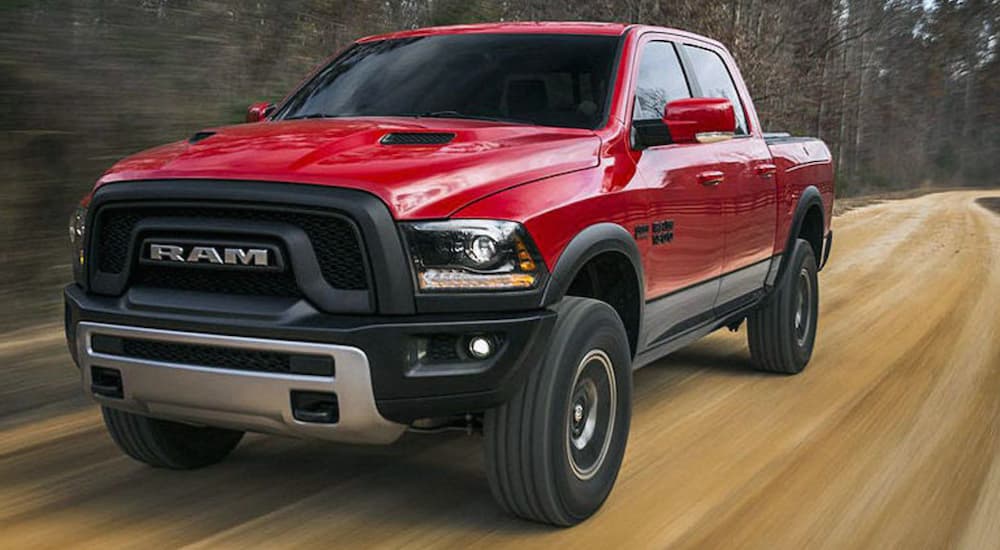
Can You Get Extended Coverage for the 100,000 Mile Ram CPO Warranty?
Yes, you can! The Certified Pre-Owned warranty coverage for Ram vehicles can either be utilized on its own or, if you want, you can make use of the Certified Upgrade Plans. This works in conjunction with the two standard warranties that come with Certified Pre-Owned Rams, including the 7-year or 100,000-mile Limited Powertrain Warranty and the 3-month or 3,000-mile Maximum Care Warranty.
The Certified Upgrade Plans allow you to choose from three different options. It’s known as the Complementary Mopar Vehicle Protection Plan, and the three different grades determine what sort of protection you want added to your Certified Pre-Owned Ram. This includes the Powertrain Care Plan, the Added Care Plus Plan, and the Maximum Care Plan. Each plan offers you something extra to increase the value of your Certified Pre-Owned vehicle, ensuring that you get maximum longevity out of your purchase.
The Powertrain Care Plan gives you added coverage for the powertrain components, including the engine, transmission, and driveline, just like the standard warranty. You get additional deductibles at $0, $100, and $200 per visit, and it covers over 350 different components. The terms for the Powertrain Care Plan can extend between 5 and 8 years at up to 125,000 miles. Alternatively, you can go with a 5-7 year plan with unlimited miles.
The Added Care Plus adds additional coverage for between 5 and 8 years as well. The mileage terms are available between 60,000 and 150,000 miles. The Added Care Plus features key fob repairs or replacements in case of damage, as well as $1,000 trip interruption protection in case your Ram is no longer operable. Trip interruption covers expenses for lodging, food, and car rentals. You also have the typical services, such as roadside assistance and car rental allowance. The coverage for the Added Care Plus also covers everything from the engine and transmission to drivetrain components such as rear-wheel drive and four-wheel drive configurations, and even the steering systems. Suspension, air conditioning, brakes, and electrical systems are also covered under this plan.
The Maximum Care Plan also offers optional deductibles and plan terms available between 1 to 5 years with between 12,000 miles or unlimited miles. The Maximum Care Plan also covers up to 5,000 components. The plan includes coverage for every component covered in the normal 7-year or 100,000-mile warranty, as well as every component included in the Added Care Plus, but it also includes manual interior mechanisms, all of the safety and security features, as well as instrumentation and body mechanisms.
Buy With Confidence When You Get a CPO Model
As you can see, there is a lot of reassurance that can come when you buy a Certified Pre-Owned Ram with all of the warranties it comes with. Plus, you can always tailor that coverage to get more if you think you are going to need it. So, talk to us about your warranty coverage options and how you can get your hands on a Certified Pre-Owned Ram today.
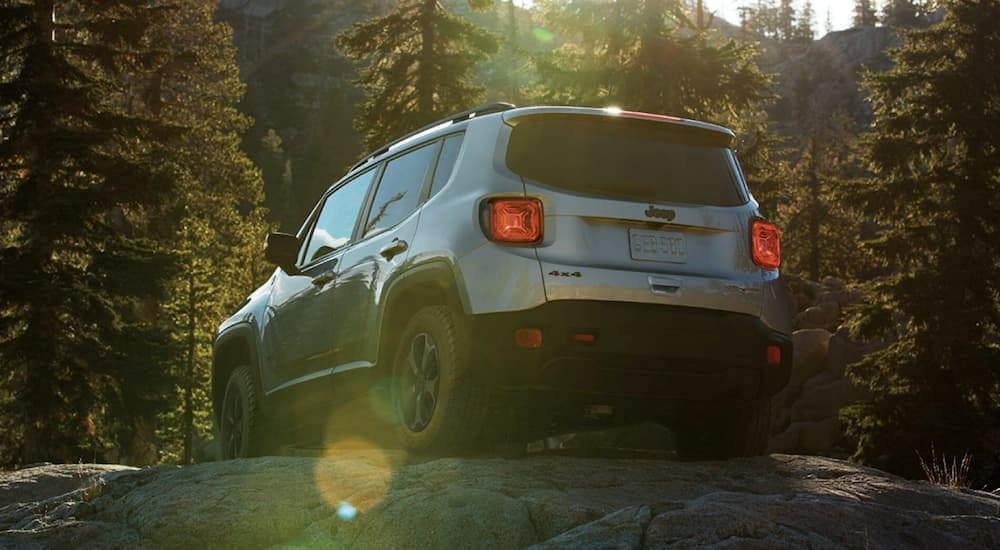
Jeep has some of the most powerful SUVs on the market, capable of mastering triumphs other vehicles in the segment could only ever dream of. It’s no surprise that a lot of people seek out Jeeps when they want a powerful SUV capable of towing, rugged traveling conditions, and off-road adventures. Given the nature of Jeep and some of the amazing line-up of vehicles under the ever-evolving portfolio of noteworthy nameplates, it seemed like a good idea to remind people about some of the best Certified Pre-Owned Jeep SUVs available on the market.
We decided to put together a list of the most powerful Jeep models you can get Certified Pre-Owned. This entails the model year and trims and why those models and trims are well worth the investment if you’re considering going the Certified Pre-Owned route. We have a diverse list of models and trims highlighted that are both powerful and feature-rich, meaning you will get the most out of one of these models used.
6: 2019 Jeep Renegade Limited
The 2019 model year of the Jeep Renegade underwent quite a few changes, upgrades, and improvements. There were enough changes that you could consider the 2019 year of the Jeep Renegade a refresh with the added stylings, the new powertrain, and all-new safety assists. It certainly fits the bill. Regardless of how the 2019 model year can be classified, the benefit of the new features and trim line-up made certain trims stand out and would make for a great pick as a Certified Pre-Owned purchase.
In particular, the 2019 Jeep Renegade Limited is probably the one you should opt for if you’re looking for a Certified Pre-Owned Renegade. Why the 2019 and why the Limited trim? Because the 2019 model introduced the 1.3-liter turbocharged engine with engine stop-start technology for the limited and Trailhawk trims, which helps improve fuel economy. But the Limited comes with some added interior luxury items, such as leather-trimmed seats with accented stitching, as well as a matching leather steering wheel and power driver seat with lumbar support. If you go Certified Pre-Owned, the 2019 Jeep Renegade Limited will give you something snazzy and luxurious for your hard-earned money.
5: 2019 Jeep Compass Upland
The Jeep Compass received a couple of noteworthy updates for the 2019 model year, one of which was the Upland trim. It fit comfortably between the Latitude and Altitude in the line-up, but it was actually much closer to the Trailhawk in terms of performance and capabilities. This is what makes it a nice pick for those looking to purchase a Certified Pre-Owned Jeep Compass. It’s not quite entirely designed to be a hardcore off-road machine, but it’s still feature-rich enough for anyone who loves a nice weekend adventure or two.
The 2019 Jeep Compass Upland is a 4×4-only trim, mated to the 2.4-liter Multi-Air 4-cylinder and a 9-speed automatic transmission. The Upland comes with a modified suspension and front skid plate, so if you were brave enough to take the Compass off the beaten path, the Upland is suited for some minor off-road excursions. The combination of class and performance puts the Compass Upland in that unique cross-section where the vehicle is designed to be fun, stylish, and refined with just enough playfulness to keep you coming back for more.
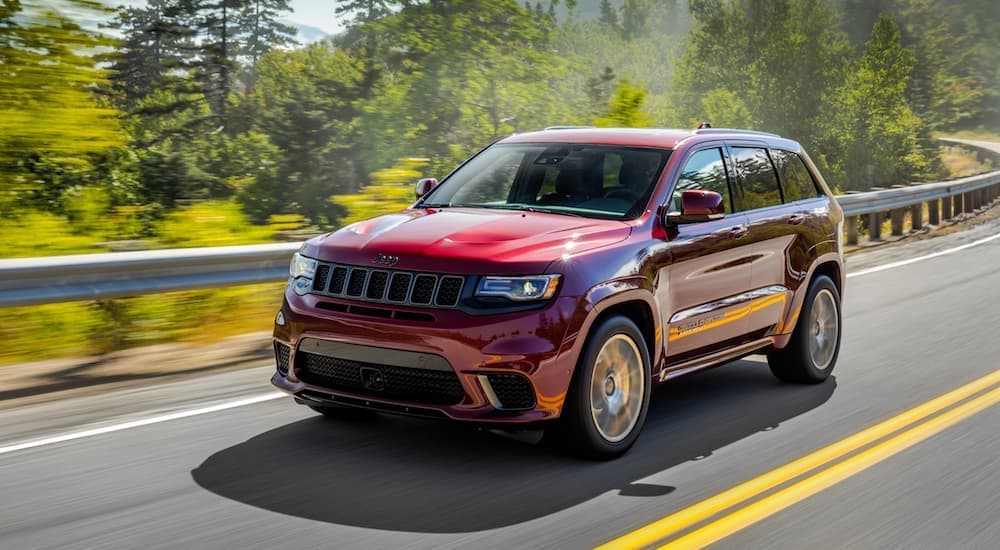
4: 2018 Jeep Grand Cherokee Trackhawk
Moving up the list, we have one of the more powerful and recognized entries in Jeep’s recent production line-up. The 2018 Jeep Grand Cherokee Trackhawk is a model year and trim that makes an easy pick when buying Certified Pre-Owned. The Trackhawk trim was a recent addition to the 2018 model year line-up, following the introduction of the Trailhawk just a year prior for the 2017 model. The Trackhawk was actually the result of several years of major improvements, including an overall weight reduction of the vehicle and improvements to the powertrain.
The 2018 Jeep Grand Cherokee Trackhawk doesn’t just have a domineering and intimidating trim name; it also comes with an equally domineering powertrain setup. We’re talking a supercharged 6.2-liter Hemi V8 with a massive 707 horsepower output and up to 645 pound-feet of torque. This notoriously powerful iteration of the Jeep Grand Cherokee is a musclebound SUV designed for only the most willing of drivers. It makes for a great choice for a used Certified Pre-Owned Jeep, thanks to its power, its prestige, and the fact that Certified Pre-Owned means you can get it for a much lower price than the original MSRP.
3: 2021 Jeep Gladiator Mojave
If you’re going to buy a Certified Pre-Owned Jeep, why not go with the first-ever desert-rated midsize truck? There’s a strong case to be made for choosing the 2021 Jeep Gladiator Mojave, not only because of its rugged good looks but also because of its more-than-capable powertrain. The Gladiator Mojave trim was one of the many trims made available for the Jeep Gladiator pickup, designed to combine off-road capabilities with traditional pickup truck functionality.
The Jeep Gladiator Mojave isn’t just named after a desert for no reason; it’s designed to tackle and conquer deserts all day long. This is all possible thanks to being specially tuned and designed for harsh off-road sessions. With FOX hydraulic jounce bumpers and bypass shocks with external reservoirs, you get maximum response from the suspension no matter the terrain. The added ability to lock the axles or enable 4×4 mode with the press of the button, and it’s easy to see why the Jeep Gladiator Mojave is a must-have selection for those looking to buy Certified Pre-Owned.
2: 2020 Jeep Wrangler Rubicon EcoDiesel
For years many enthusiasts had been begging Jeep to make a proper diesel iteration of the Wrangler. So Jeep obliged with the 2020 model year Wrangler by not just adding a diesel, but an eco-friendly diesel aptly named the EcoDiesel. This optional powertrain gained much of its popularity being attached to the more hardcore iterations of the Jeep Wrangler, including the Wrangler Rubicon. This trim has established itself as the go-to solution for those who want a high-end, high-performance off-road experience, and with the EcoDiesel attached, that goal is more than satisfied.
The 2020 Jeep Wrangler Rubicon EcoDiesel pumps out 260 horsepower and 442 pound-feet of torque and also manages some of the best fuel economy ratings in Wrangler history. The combination of the low-end torque V6 diesel and the Rubicon’s made-for-punishment suspension means you’ll have no problems tackling some of the roughest terrains you can find for the Wrangler. This is certainly a choice selection for those looking for a very specific Certified Pre-Owned Jeep model that doesn’t cut any corners when it comes to power output.
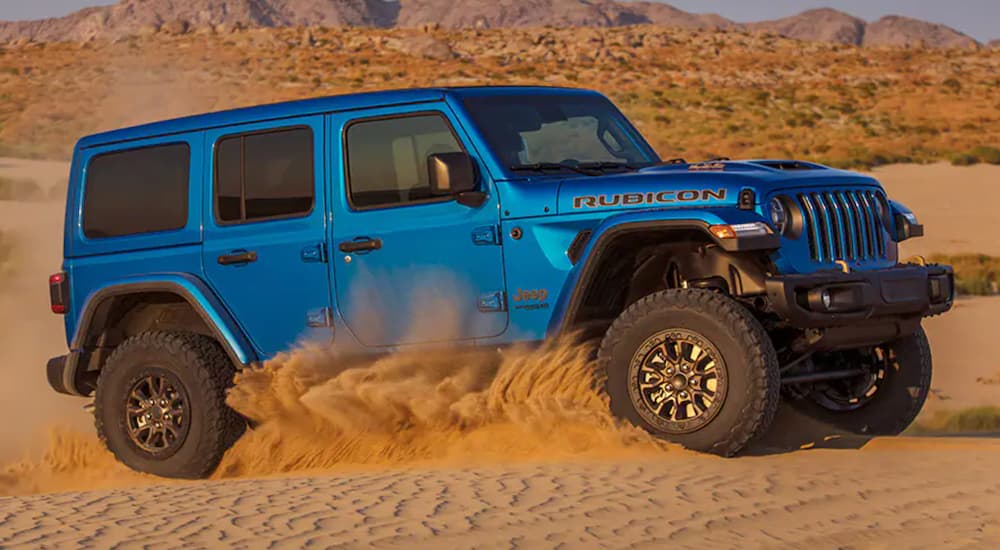
1: 2021 Jeep Wrangler Unlimited Rubicon 392
Keeping in line with hardcore off-road models, the 2021 Jeep Wrangler Unlimited Rubicon 392 is a beastly SUV. The 2021 model year introduced a number of impressive new features, including the 4xe hybrid powertrain for the Rubicon. However, it was the all-new Hemi V8 that helped set the world of off-world traversal on fire. The Rubicon 392 came onto the scene being billed as the most powerful Wrangler yet, and it’s so very easy to see why.
The 2021 Jeep Wrangler Unlimited Rubicon 392 features a 6.4-liter Hemi V8 that produces 470 horsepower and up to 470 pound-feet of torque that can be accessed within the lower revolution range. With the added off-road suspension capabilities designed for extreme articulation and travel, and featuring electronic disconnecting sway bars and FOX shocks, the Wrangler Unlimited Rubicon 392 is both the ultimate Wrangler and the ultimate off-road machine. It’s a powerful SUV to be reckoned with, and perfect for uphill climbs, rock crawls, and punishing off-road trails. If you want one of the most powerful Certified Pre-Owned Jeeps, then you definitely need to go with a Jeep Wrangler Unlimited Rubicon 392.
Connect with us


